In the Loop· September 11, 2026
AI-Powered Knowledge Base Software: 3 Things to Check Before You Buy
“AI-powered” gets stamped on almost everything now. Most of it means a chatbot bolted onto a search box: a friendlier interface wrapped around the same plain search, inheriting every one of its weaknesses.
It doesn’t know which document is current. It can’t tell relevant from stale.
Three things separate real retrieval from that kind of wrapper, and all three are checkable in a live demo, not just claimed in marketing copy.
Chunking. Does it break documents into pieces small enough to retrieve precisely, or does it hand the model whole documents and hope?
A vendor that can’t explain their chunking approach in plain language usually doesn’t have one worth explaining. Ask what happens to a fifty-page policy document: does it get cut into sections a query can target, or does the whole file get shoved at the model every time?
Citation. Can it show you which document, which section, produced this answer? If it can’t point to a source, you can’t verify it.
This is the difference between an assistant that says “here’s why” and one that just says “trust me.” A tool with real citation shows you the passage it pulled from, not just a filename.
Source pointers. When a document updates, does the system know the old version is superseded, or does it keep surfacing both?
This is the check most demos never get to, because it requires uploading two versions of the same document and asking a question the old one would answer wrong. It’s a rarer ask than chunking or citation, precisely because so few buyers think to make it.
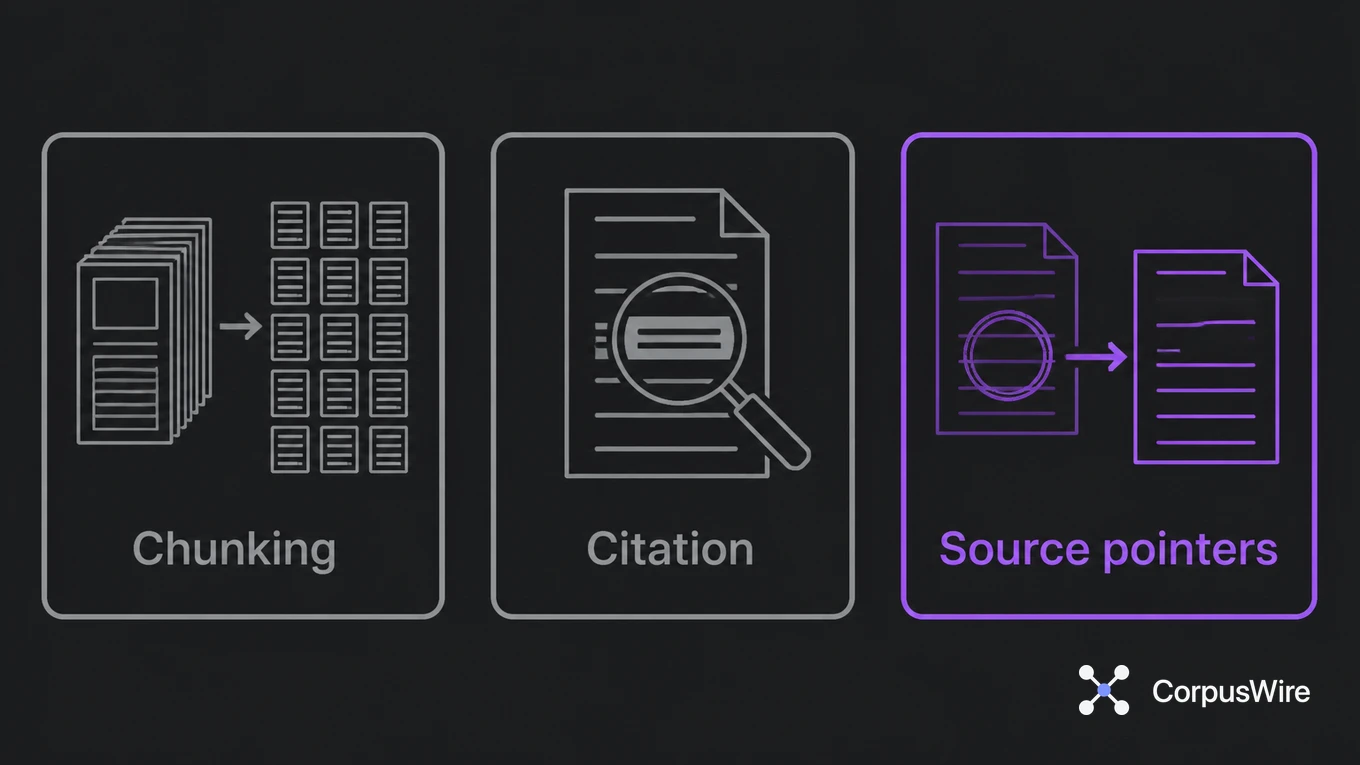
Ask any vendor these three questions in a live demo, not in their marketing copy. Watch what happens when you ask them to show the source behind an answer, live, on a document you just uploaded.
Bring your own test document. Upload an internal file, something like a pricing sheet with a superseded number still visible in the footer, and ask a question the old number would answer wrong.
A vendor with real retrieval will chunk it, cite the specific section it pulled from, and either flag the outdated figure or ask which one is current. A vendor without it will confidently answer from whichever version it happened to grab first, footer and all, and never mention there might be two.
Vague answers to a direct question are the tell. If a vendor can’t show chunking, citation, and version handling in front of you, “AI-powered” is doing marketing work, not describing the product.
Price shouldn’t be the first filter here, and neither should the length of the feature list. A tool that nails these three mechanics with a plain interface beats one with a polished dashboard sitting on top of a chatbot wrapper.
Watch for the sales pitch that jumps straight to integrations and seat counts before answering the chunking question. That ordering is itself a signal: a vendor confident in their retrieval mechanics tends to lead with it, because it’s the part that differentiates them from a generic wrapper.
There’s a fourth thing worth watching even though it doesn’t fit neatly into the three-check framework: what happens when the tool doesn’t know the answer. Ask it a question your documents genuinely don’t cover.
A tool with real retrieval will say so, plainly, because it can tell the evidence isn’t there. A chatbot wrapper will often answer anyway, filling the gap from the underlying model’s general training instead of your actual documents, and there’s no way to tell the difference just by reading the answer.
That failure mode is worse than a wrong citation, because it looks identical to a correct answer until someone happens to check. Ask the decline question in every demo, not just the version-handling one.
Budget matters less here than sequencing. A team that checks these mechanics before comparing pricing ends up comparing tools that work the same way; a team that starts with pricing ends up justifying whichever tool it already picked.
FAQ
Isn’t any tool with an AI chatbot technically “AI-powered”? Technically, sure, which is exactly why the phrase shows up on products with nothing but a wrapper underneath. A useful substitute question when a vendor uses it: what does the product do differently from a general chatbot pointed at your files?
What’s the fastest way to test a vendor’s claims in a demo? Upload a real document with two versions, ask a question the old version would answer wrong, and see whether the tool surfaces the current one, cites it, and flags the old one as superseded.
Should a longer trial period be a dealbreaker if a vendor won’t offer one? It’s a caution flag, not an automatic dealbreaker. A vendor confident in real chunking, citation, and version handling usually has no reason to avoid a short trial against your own documents, since that’s exactly the test that shows their product working as claimed.
Want this running inside your own org?
Happy to show you how this fits your setup. 30-minute call, your documents, no prep needed.
Book a call →