Law 2 - Your One Advantage Competitors Can Never Copy
Contents
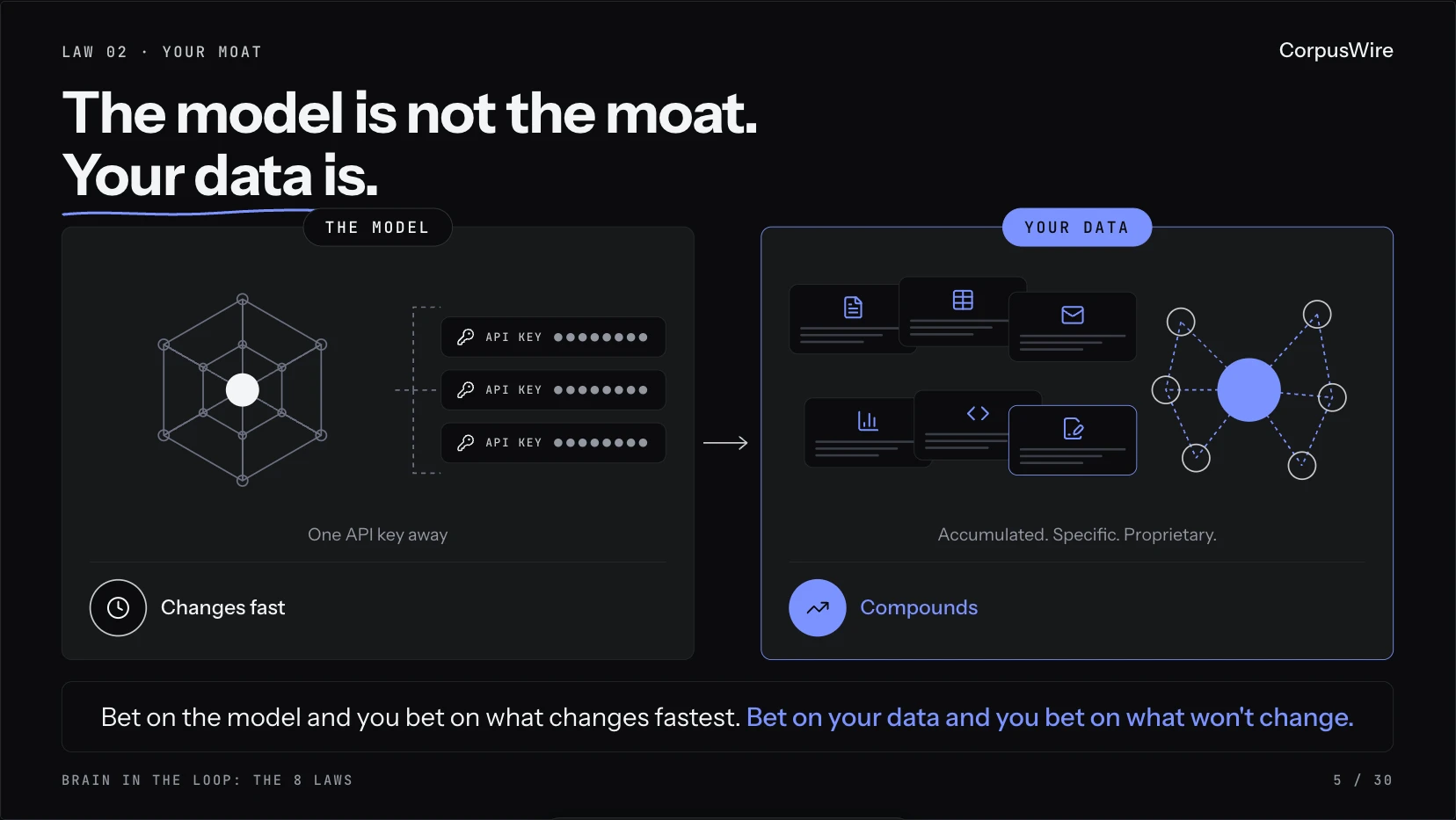
Your competitor is one API key away from the same model you use. The one input they cannot rent is what your business knows.
Every business has private information the AI does not have. Two firms can run the exact same model, and only one of them has your decade of client work, your SOPs, your decisions and the reasons behind them.
The number: models are a commodity now
In March 2026 AI Ireland stated the law almost word for word. AI models are becoming a commodity, the technology a competitor can buy is nearly identical to yours, and the one thing they cannot buy, borrow or replicate is your data. The same piece notes Gartner now classifies foundation models as “strategic commodities”.
It also puts a number on the gap. Companies most exposed to AI disruption underperformed the most AI-resilient companies by nearly 26 percentage points in early 2026. And citing Morningstar, it reports that four of the five classic competitive-moat pillars now have almost no predictive power in an AI market.
They can buy the same model, but they can’t buy what you know.
The SOP-shaped hole
Here is what the moat looks like in an ordinary week, rather than in a strategy deck. Ask an AI to carry out a task your business performs regularly, and give it no SOP. It will make up its own version of the task, and that version will not match how you actually operate.
An AI answer is clearly better with access to your private information than with public information alone, depending on what you’re asking. The gap between those two answers is your proprietary process, and it is exactly the thing a competitor’s model cannot see. The RAG explainer covers the mechanism: an answer that comes from your own documents rather than the public internet with your logo attached.
The objection worth taking seriously
Sceptics of this law make a fair point, and it strengthens the law rather than weakening it. Data sitting still is not a moat, because storage is a cost. A moat is a loop: use generates knowledge, the knowledge improves the next answer, and the better answer drives more use.
I agree with that entirely. A corpus nobody adds to and nobody retrieves from is a filing cabinet with a monthly bill. The moat is a corpus that is captured as the work happens and queried when the next decision comes up.
Which is also where the limitation sits. Most businesses do not produce much documentation, so their moat is mostly potential. AI changed that by making transcripts, analyses and reports cheap to generate; it did not fill anyone’s corpus for them.
How I check for a moat in a new client
When I start with a new client, the first thing I look for is evidence of a sustainable competitive advantage: a patented technology, a distinctive dataset, or a specialised process competitors cannot easily replicate. Almost always, the process is the one that exists and is written down least.
Try the same check on your own business. Name the one process a competitor with your exact model could not reproduce, then go and look for where it is written. If you cannot point to it, that is the moat you have not dug yet.
FAQ
Google already indexes my website. Isn’t that my data in the AI too? Google and web search can scrape what you publish, and so can any model with a search tool. Neither has access to your private conversations, your internal documents or your call recordings, and that private half is where the moat lives.
My competitors have the same documents I do, such as contracts and price lists. Where is the moat? In the parts they don’t have: your decisions and why you made them, your SOPs, what went wrong last time and what you changed. A competitor may hold the same kind of documents, but not your history.
Can’t I just put my documents in the AI tool’s project memory? You can, for one tool. Project- and document-based AI memory is specific to the vendor that provides it, so it doesn’t transfer when you use a different model. A corpus behind MCP gives the same dataset to any AI, updated in real time.
What if my business is small and has little written down? Then the moat is mostly still to be built, and that is the honest answer for most businesses. Start by recording and transcribing meetings, since they generate the operating knowledge nobody else has, and the AI can turn a recording into a document at almost no cost.
Does the moat still hold when a better model launches next month? Yes. The model changes; your data stays where it is. Whichever model leads this month, a competitor can access comparable capability quickly, and none of it includes what your business knows.
This is the second of eight laws behind how an AI-native business gets built.