Law 7 - The Single Point of Failure That Threatens Your Entire AI Setup
Contents
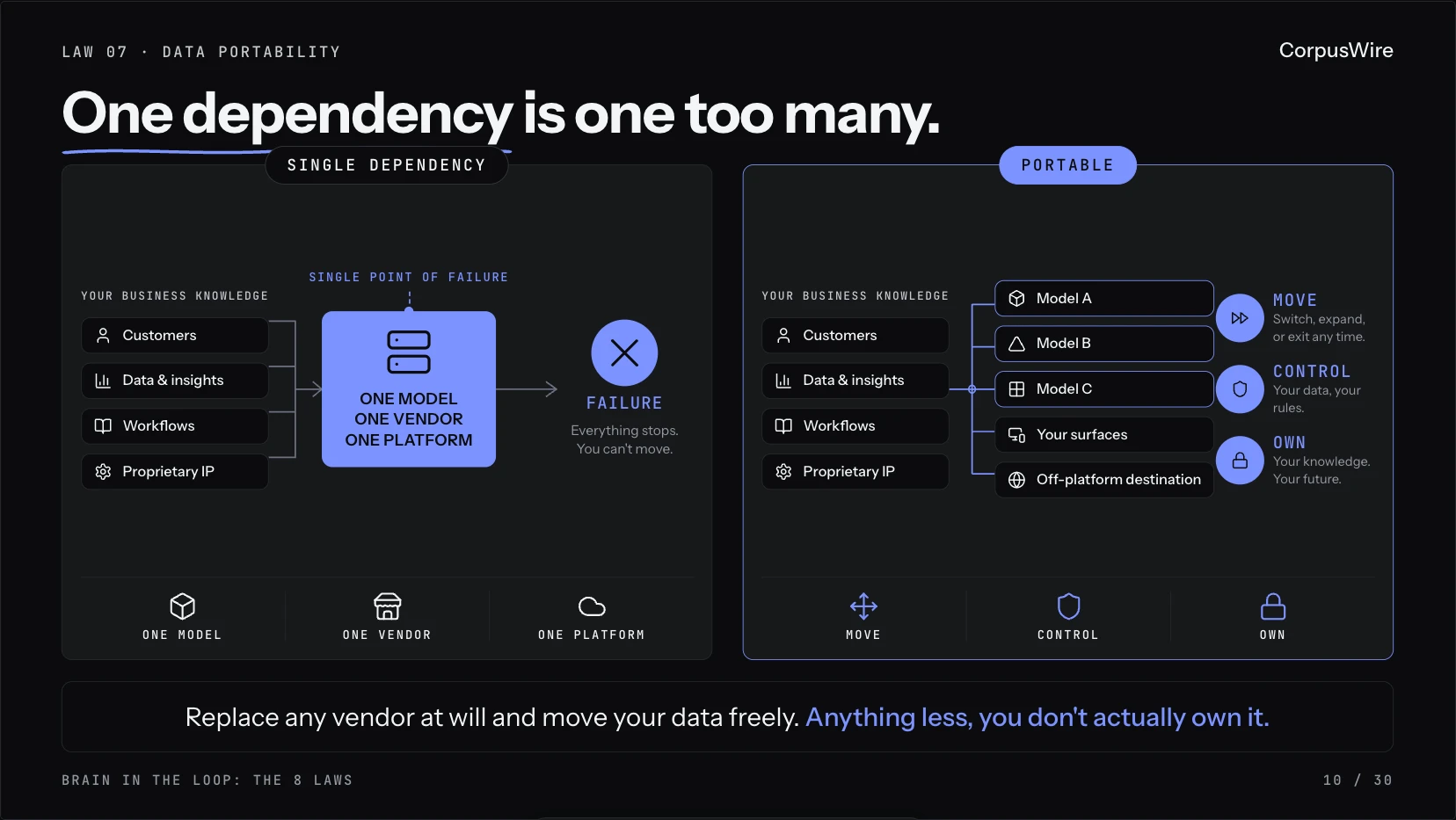
One is the worst number in business. One model, one vendor, one platform whose roadmap you don’t control: each is a single point of failure dressed up as convenience.
The model being replaceable simply means you can use ChatGPT instead of Claude, or the other way round, without your business noticing. That sounds obvious until you look at how people actually work.
The number: every major vendor, inside twelve months
MCP, the protocol that lets an AI client query your knowledge directly, launched in November 2024. By its first anniversary, the official retrospective could list OpenAI integrating it across ChatGPT and its developer platform, Google DeepMind adding it to Gemini, and Microsoft and GitHub shipping support. Thousands of servers were live by then.
That matters for this law because portability needs a standard. When every major provider reads the same protocol, your knowledge layer can be reached from any of them, and none of them owns it.
How people get trapped
People get trapped in one model out of habit. It is simpler: you build familiarity with one interface and want to use that tool for everything, even when another is better for the task.
That habit creates the single point of failure, and it costs twice. You get worse results from the wrong-fit tool, and you have nowhere to go when that tool is down.
I have tested this directly. Claude, ChatGPT and Grok all connect to the same CorpusWire Brain over MCP and retrieve from it equally well; those are the three I have tried, and there are more. The choice of model stopped mattering once the knowledge layer was separate from it.
My own hedge is deliberate: Anthropic for writing, OpenAI for image generation. Two providers, so a bad day at one is an inconvenience rather than a stoppage.
The memory feature that isn’t yours
Tie your knowledge to a single AI’s built-in memory and you have handed your most valuable asset to someone whose pricing, terms and existence you don’t decide. They decide what it costs next year, whether it survives the next model release, whether the data is portable when you leave, and what access looks like if they get acquired.
None of that requires anyone to be malicious. It follows from a structural choice that put someone else in control of what you know, and every time their roadmap changes, your most valuable institutional asset moves with it.
Project memory is also AI-specific, so it does not transfer. I would add, from using it, that it is transient and flaky and needs constant updating, which is a smaller problem than ownership but a daily one.
A system you can’t move, across models, across surfaces, off the platform entirely, is a system you don’t own. Plain text and an open protocol are what make it movable. Portability is a design choice made at the start, and the honest cost is that you have to keep making it: a second provider needs setting up, and habit pulls you back to one.
A check you can run now
List the AI providers your business actually used this month. If the answer is one, you have found your single point of failure, and it is worth knowing before that provider’s next pricing change rather than after.
FAQ
What should I export this week? The documents your business runs on, as plain text, into a store you control. Then check whether anything you rely on exists only inside an AI tool’s project or memory feature, because that part does not come with you and needs writing down somewhere that does.
If my knowledge is portable, what does moving it actually involve? Plain-text documents move by copying. The searchable index built on top of them is rebuilt on the new platform, which is a mechanical job, not a rewrite. Nothing that lives in a vendor’s memory feature comes with you.
Does this mean I shouldn’t use ChatGPT’s or Claude’s memory at all? Use it for convenience, not as the place your business knowledge lives. Anything that matters belongs in a corpus you own and can reach from any model.
Which vendor should I standardise on? None, which is the point. Standardise on the protocol and the format, MCP and plain text, and pick models by fit for each task.
What happens when a provider has an outage? If your knowledge layer is separate and reachable from another provider, you switch and carry on. If it lives inside the provider that is down, so does your afternoon.
This is the seventh of eight laws behind how an AI-native business gets built.