Law 6 - The One Place Your Business Knowledge Must Live But Probably Doesn't
Contents
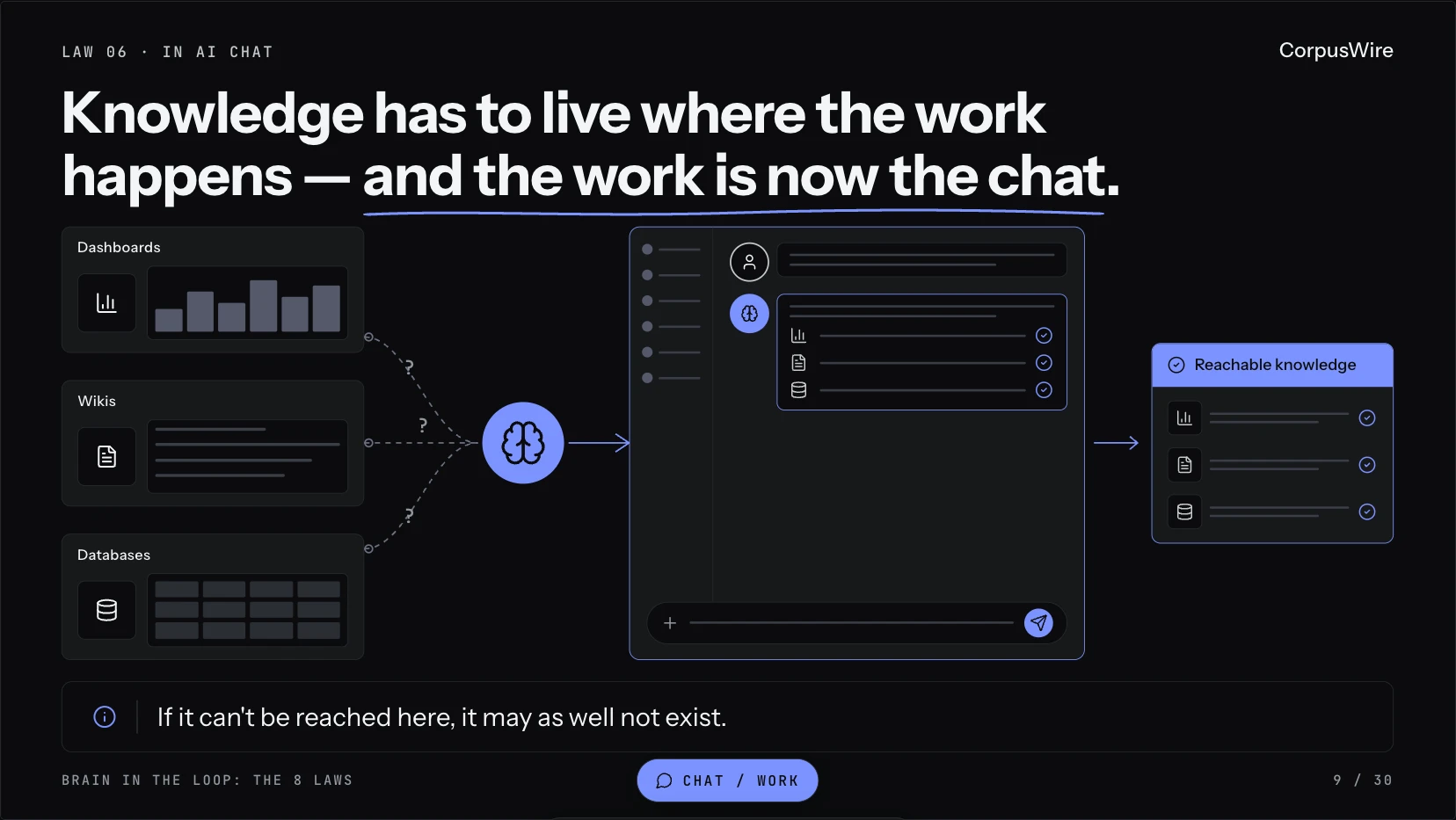
Knowledge that makes you stop, open a new tab and go looking does not get used. More of your work now starts in a chat window, and that is where the knowledge has to be.
Wikis and dashboards are rarely badly built. They fail for a structural reason: the knowledge lives somewhere you have to go to, and the friction of the trip costs more than the value you expect to get back. So you skip it.
The number: two months to 100 million
ChatGPT reached 100 million monthly users about two months after launch. UBS analysts, who had tracked consumer internet apps for twenty years, said they could not recall a faster ramp. TikTok took nine months to reach the same figure and Instagram took two and a half years.
That is the interface, not the model, and it is the point for this law. The chat window became the fastest-adopted piece of software most working people have ever used, and it is where more of the work now begins.
Eighteen spreadsheets and one tool
I worked with a client team of twenty. They had a project-management tool, and two of the twenty used it. The other eighteen ran their own spreadsheets, so everyone was doing something different and the problems were exactly what you would expect.
Spreadsheets are easy to start and hard to scale once operations get complicated, and most project-management tools I have used are clunky. Clunky interfaces are the biggest single killer of adoption I have seen.
We once held a lifetime licence for Nifty, which now costs nothing, and nobody used it because the interface was poor. We moved to Linear, which has a great interface, and I still never open it directly. I work with it through AI.
The best kind of software is the kind you never have to interact with directly. You use it where you already are, and increasingly that is inside a chat.
How the knowledge gets there
The mechanism is MCP, the Model Context Protocol. A knowledge layer that exposes an MCP server can be queried from inside any compatible AI client, in the same session, with no export and no separate window. The operating layer post describes the difference: a library you open versus a memory the AI reads mid-task.
The limitation is that not everyone on a team works in a chat yet. Some of that client’s people still needed to log into Linear directly, and a good interface mattered to them. The rule is that the knowledge has to be reachable from where each person’s work actually happens, and for more of them each year that place is the chat.
Finding out whether yours is used
Do not guess, because your admin panel already knows. Drive shows when a document was created and when it was last opened; your task tool shows when a task was touched. Pull the last-opened dates for the knowledge tool you pay for, and you will have your answer in a minute.
FAQ
We have a wiki. Shouldn’t knowledge live there? A wiki is where knowledge is stored, which is different from where it is used. This law is about knowledge arriving where you already are, so keep the wiki for people who want to read a page and connect its authoritative content to the tools your AI works in.
Does this mean every tool needs an AI chatbot bolted on? No, and that is usually the wrong direction. The chat is where the person is; the knowledge and the tools connect into it through MCP. One chat, many connections, rather than a chatbot in every product.
What is MCP, in plain terms? An open protocol that lets an AI client query a data source directly, so your corpus or your task tool can be read from inside the conversation. Claude, ChatGPT and Grok all support it, which is why the same corpus can be reached from any of them.
What if my team doesn’t use AI chat much yet? Then start where they do work. The principle is knowledge where the work happens; for some people that is still a tool with a good interface. The trend is that more work starts in chat every year, so build the connection now rather than after the shift.
Won’t people still ignore it? Some will. The difference is friction: knowledge that appears in the answer costs nothing to use, and knowledge that requires a trip gets skipped. Removing the trip is most of the battle.
This is the sixth of eight laws behind how an AI-native business gets built.