Law 1 - Your #1 Business Asset That's Hidden In Plain View

Contents
Most of what your business has written down is never looked at again. Not lost. Just sitting there, human or AI, going to waste.
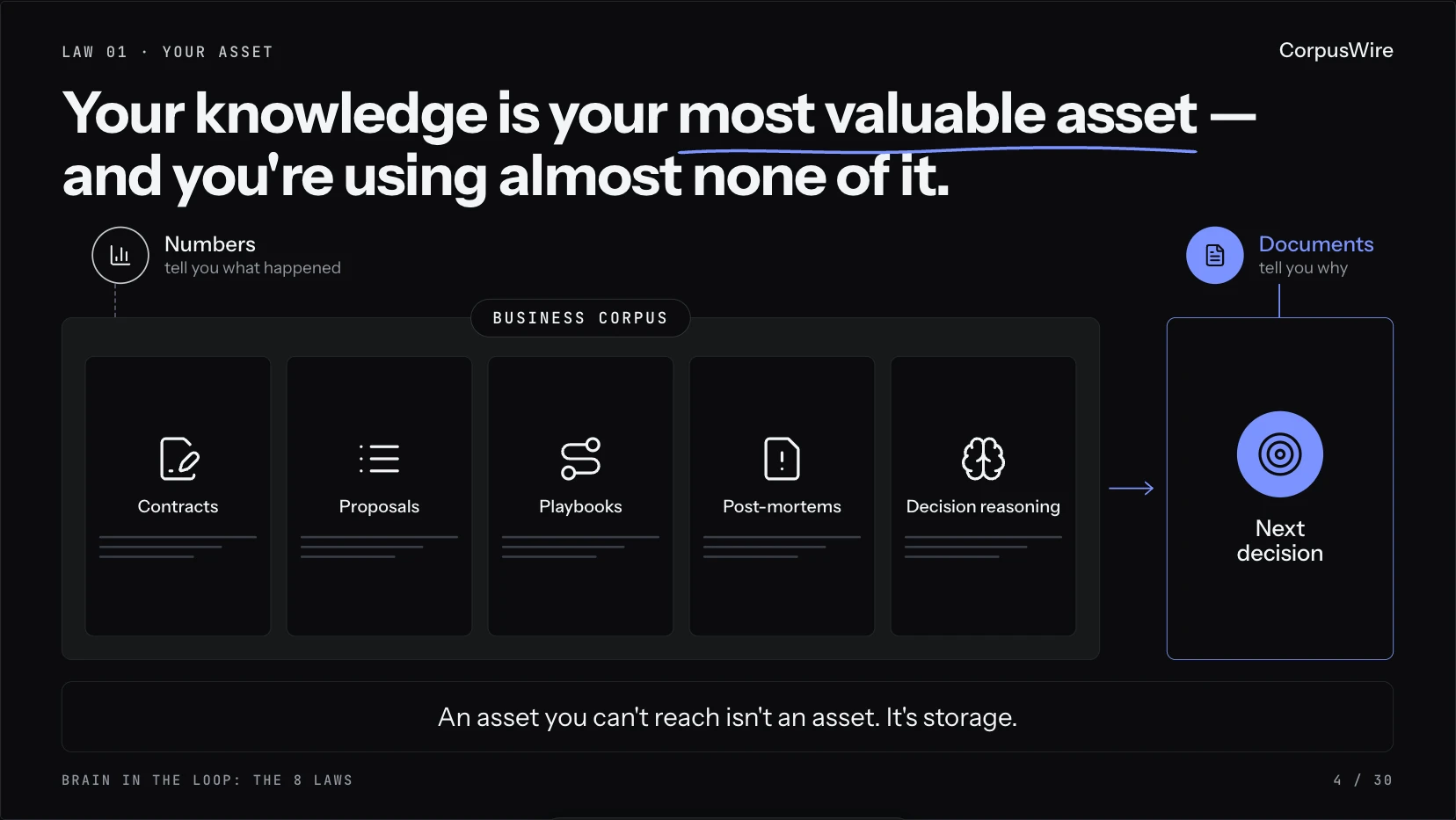
Every business sits on a corpus: contracts, proposals, playbooks, post-mortems, the reasoning behind every decision it ever made. Your numbers tell you what happened. Your documents tell you why.
That “why” is the most valuable data you own. Almost all of it is dark: written once, filed, never read again, never informing the next decision. Until something is queryable, it doesn’t exist as data. It exists as files.
An asset you can’t reach isn’t an asset. It’s storage.
The Number Behind This
This isn’t a guess about your business specifically. Seagate’s Rethink Data report, based on an IDC survey of 1,500 global enterprise leaders, found that 68% of the data available to enterprises goes unused. Only 32% is put to work.
IDC’s research director on the study called it dormant potential, not a lost cause. Businesses that learn to use what they already hold gain a real advantage over the ones that don’t.
You’ve stored it for years. That’s not the same as using it.
What This Actually Costs
The number isn’t abstract. McKinsey Global Institute found knowledge workers lose an average of 1.8 hours a day, roughly 9.3 hours a week, just searching for information they already have somewhere.
HBR’s analysis of Bloomfire’s enterprise data, drawn from 115 companies over six months, found this inefficiency costs businesses an average of 25% of annual revenue. Employees spend 21% of their time searching for knowledge and another 14% recreating information they couldn’t find.
Panopto’s research calls this the “fifth employee” effect. A business effectively pays for five people, but only four show up, because the fifth spends the day searching for answers that already exist somewhere in the company.
This Isn’t a New Problem
Spreadsheets made numbers operational. Before that, numbers sat inert in ledgers, real but useless for running a business day to day. Documents are the next category due for that same shift: briefs, decisions, lessons, SOPs, client correspondence, project notes, retros, scoping conversations.
The substantive record of how your business actually works is sitting in folders right now, illegible to any AI tool that could use it.
What This Looks Like Day to Day
Here’s how this shows up day to day. Every new AI session starts from zero, and you’re the one rebuilding it.
You re-explain the business. You re-upload the same files. You re-state conventions you already stated last week.
A brief drafted in ten minutes saves time on the brief and burns it on setup instead. Five times a day, every day, the context you built just expires.
This is the same failure mode behind why exporting your ChatGPT history isn’t actually a fix: the conversation gets saved, but nothing about it becomes reusable. It’s also the exact cost this piece breaks down directly: what switching between AI tools all day actually costs you.
The cause is structural: there’s no layer underneath the session that already knows your business, so every conversation starts as a fresh ask instead of a continuation.
Closing that gap is what turns AI from a productivity tool into operating leverage. It’s also the real difference between a knowledge base and an AI operating layer: one stores documents, the other makes them reachable at the moment work happens.
FAQ
Isn’t this what a shared drive or wiki is already for? A folder holds files. It doesn’t make them retrievable when a person or an AI tool actually needs them, and nobody goes back to extract structure from a document once it’s filed. The knowledge exists; the retrieval layer doesn’t.
Where would we even start, if none of this has ever been organized? Start with what already exists: contracts, playbooks, decisions, the notes from the last project retro. Most businesses have more of this than they think. The work is making it addressable, not writing it from scratch.
Is this just a big-business problem? The 68% figure comes from enterprise data, but the mechanism is the same at any size. A five-person team re-explaining context every session loses the same hours per person as a five-thousand-person one, just on a smaller total bill.
Isn’t this what business intelligence tools already solve? BI tools operationalized your numbers. This is documents: the reasoning, decisions, and context your numbers never captured. Different data, same unindexed problem.
What’s actually stopping businesses from fixing this already? Not awareness. Most people already sense their documents are underused. The gap is that indexing them was never anyone’s job, and no format made it cheap enough to do as a byproduct of normal work.
This is the first of eight laws behind how an AI-native business gets built.