Law 5 - How To Activate The 'Compound Effect' For Your Data
Contents
Why did we make that decision, and when? If nobody wrote it down, your business is about to work it out for the second time.
This happens all the time with the clients I work with who have no system for it. Pricing changes, marketing strategy, website content: decisions get revisited because the original reasoning was never captured. Operational detail gets discussed in meetings and evaporates when the meeting ends.
The test for this law is simple. Is your knowledge worth more after a year of use than it was before?
The number: a company run from its handbook
GitLab is a publicly listed software company of roughly 2,000 people across more than 65 countries, with no office. It runs on a public handbook, thousands of pages long, where processes and decisions are written down before they are acted on. Every question starts with a search of the handbook, and every section has an owner who reviews changes.
Sources disagree on the page count, so I won’t commit to one. What matters is the operating rule underneath it: a company that does not document has no choice but to watch its people ask for the same information again and again. GitLab chose to write it down once.
Going in circles
When I work with a client who has no system like this, I build my own. Week after week it gives me the answers when the questions come up: what was decided, when, what changed, who changed it. Without that, you go round in circles reconstructing the reasoning.
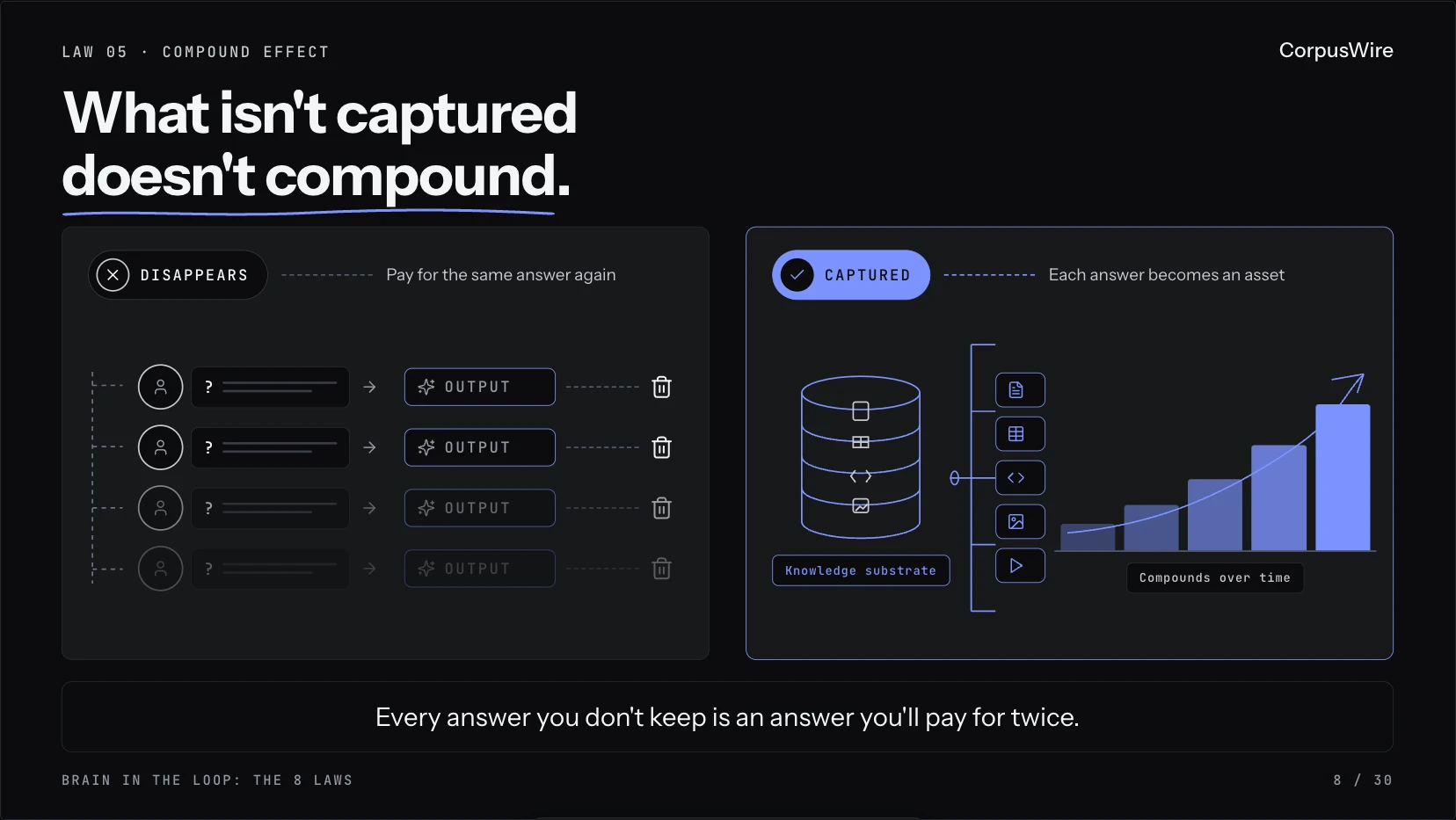
Most AI use makes this worse rather than better. You run a session, get an answer, close the tab. Whatever the model worked out, the framing that clicked or the edge case it spotted, is gone, and the next session starts from zero.
The enemy was never manual work. The enemy is work that does not compound.
The fix, and what it costs
When the AI works something out, capture the useful part as candidate knowledge. Review it, and if it holds, promote it into your corpus, so every future session, hire and project can find it. The second time that knowledge is needed, it costs nearly nothing.
The cost is the review. Candidates need a person to look at them, and if nobody does, you have a pile of the AI’s own output waiting to be trusted. That is a real, ongoing job, and it is the reason most implementations skip it.
The operating layer post describes the version that works: the corpus updates from where the work happens, rather than as a separate maintenance task somebody has to remember.
I have no single dramatic incident to offer here. This failure comes as a pattern, repeated quietly across every business I have seen without a system, and I include my own before I built one.
One question to ask on Monday
Pick the last decision your team revisited, on pricing, on a campaign, on a page of the website. Can anyone find why it was made the first time, without asking the person who made it?
If the answer lives in someone’s head, that is where it will stay when they leave.
FAQ
Isn’t this just documentation, which nobody keeps up? It used to be. Documentation was expensive to produce and expensive to keep current, so businesses did a poor job of it. AI changed the economics: meeting transcripts, analyses and reports are now cheap to generate, which is exactly why capturing them is worth doing now and was not worth doing before.
Does every meeting really need recording? The internal ones are where the operating knowledge is, and they are the ones almost nobody records. Sales teams already record and analyse their calls; the same practice applied to operations meetings is the cheapest compounding you will find.
How do I stop the corpus filling with junk? Review before promotion. The AI proposes candidates; a person decides what becomes canonical. Skip that step and you are compounding guesses.
Can I retrieve a decision’s reasoning without exposing client details? Yes. A search returns the reasoning, and it can do that without surfacing the specific client information that sat around it. Retrieval is about the “why”, and the “why” is usually not the sensitive part.
What about knowledge that walks out of the door with a leaver? That is the same loss at a different speed. Knowledge that lives only in someone’s head or in a meeting nobody captured leaves with them; knowledge that was promoted into the corpus stays.
This is the fifth of eight laws behind how an AI-native business gets built.