An accurate, real-time business brain that enriches every AI conversation.
Every AI session starts from zero. That means endlessly re-uploading business files just to give it context.
A Brain in the loop means your documents, briefs, SOPs, client work, are connected and updated in real time with your AI tools.
Your stack. Your data. No lock-in.
Works in Claude and ChatGPT · Runs on your stack · Built by MoreResults to run MoreResults since 2025
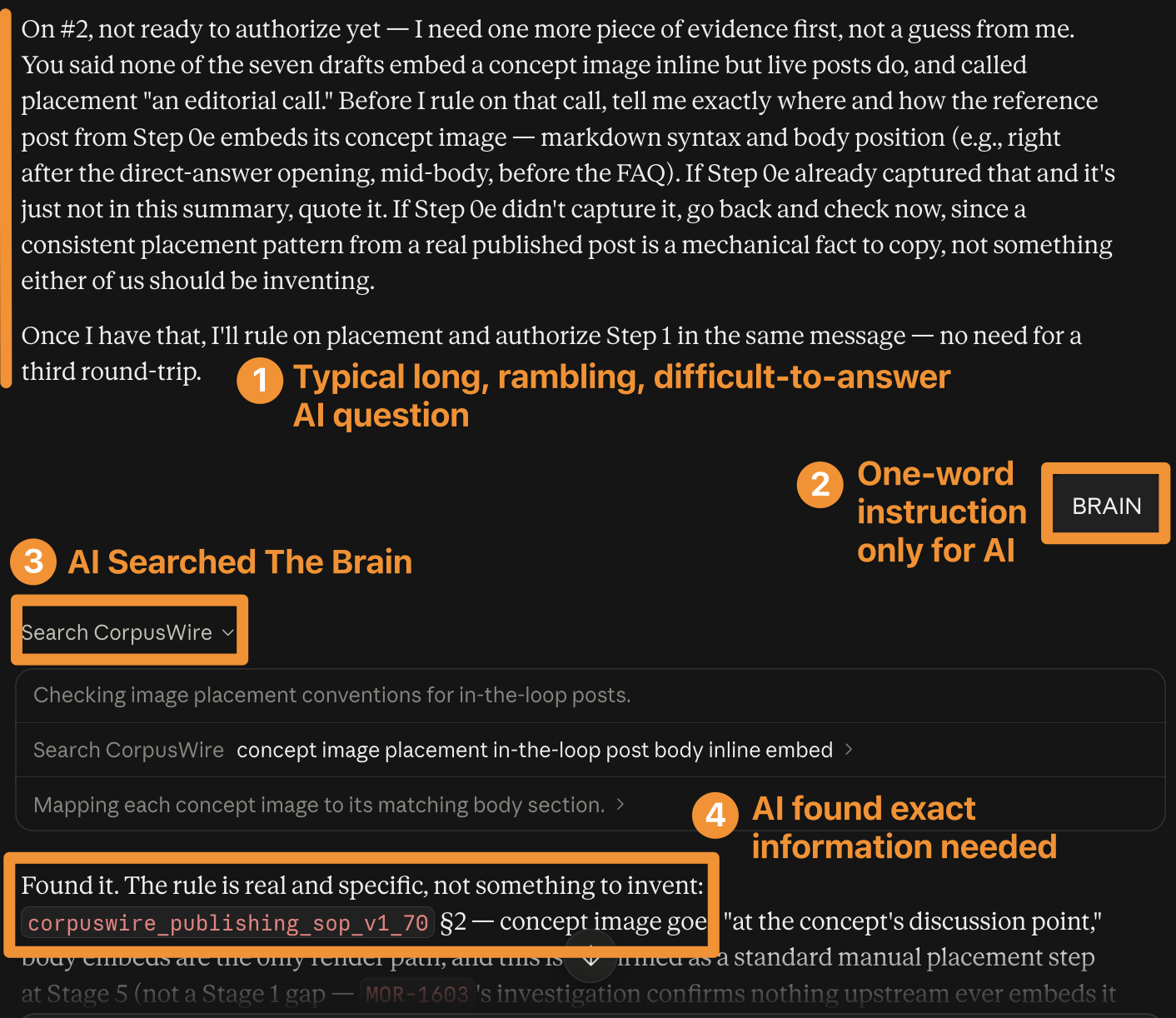
Found it. The rule is real and specific, not something to invent: concept image goes at the concept's discussion point, body embeds are the only render path.
Who this is for.
For you if
- You already use Claude or ChatGPT every day and you're tired of re-explaining your business to it
- You run a team of 5 to 25 and you're the one everyone asks because you're the one who remembers
- You want one system underneath your AI tools instead of ten more tools
Not yet if
- You chase whatever's new, even when the last thing never paid off
- You don't think your notes, SOPs, briefs and conversations are worth anything
- You want your team to figure AI out on their own
You've explained your business to AI more times than you can count. You've redone work because starting again was quicker than finding it. Every new chat starts cold.
Your Brain in the loop in 3 steps.
Your documents, wherever they already live, Dropbox or Google Drive.
CorpusWire indexes them automatically, keeps that index current, and none of it leaves your accounts.
Your AI assistant queries that index directly and answers grounded in your actual documents, cited back to source.
The Foundation: A Vector Database For RAG
A vector database turns your documents into something searchable by meaning, not exact wording.
Your AI assistant retrieves the right passages, then writes its answer from them instead of guessing.
Find the right material, then answer from it.
That combination is called retrieval-augmented generation, RAG for short.
Why I built this
In an age of ever-faster development, I believe we all need to focus on what stays the same in our business.
That's where the real impact is over time.
Chasing the latest AI tool doesn't get you there.
I couldn't find a solution that did what I wanted, cost-effectively and to a high standard.
So I built my own.
After 8+ months of constant personal use, I figured it was time to make it available to others.
The model is one API key away and changes fast. Your data is accumulated, specific, and yours. Bet on the second one.
The eight laws behind it, in full →Four components. One operating layer.
Your documents, indexed as an intelligence layer.
Hybrid search across the whole record, semantic and keyword combined.
Heading-aware chunking. Real-time ingestion as new work happens.
The operating layer keeps itself current.
Scheduled re-indexing, decay detection, and promotion review keep the canonical corpus clean.
We run this. Not you.
Your AI tools, plugged into your knowledge.
Anything that speaks MCP, Claude, ChatGPT, custom agents, retrieves from your index in the moment, in the tool you already use.
See what you've built.
A visual, explorable map of your knowledge: dense, interconnected, queryable.
See the full console →Your database · Your hosting · Your source repository · Your domain · Your Dropbox or Drive · Plain-text export any time · Infrastructure runs about $30–50 a month, billed to your own accounts
Nothing is indexed silently. You can see it.
What's indexed, what's excluded, recent activity, and a semantic graph of how your knowledge connects.
You can see the asset you've built, and you can see the gaps.
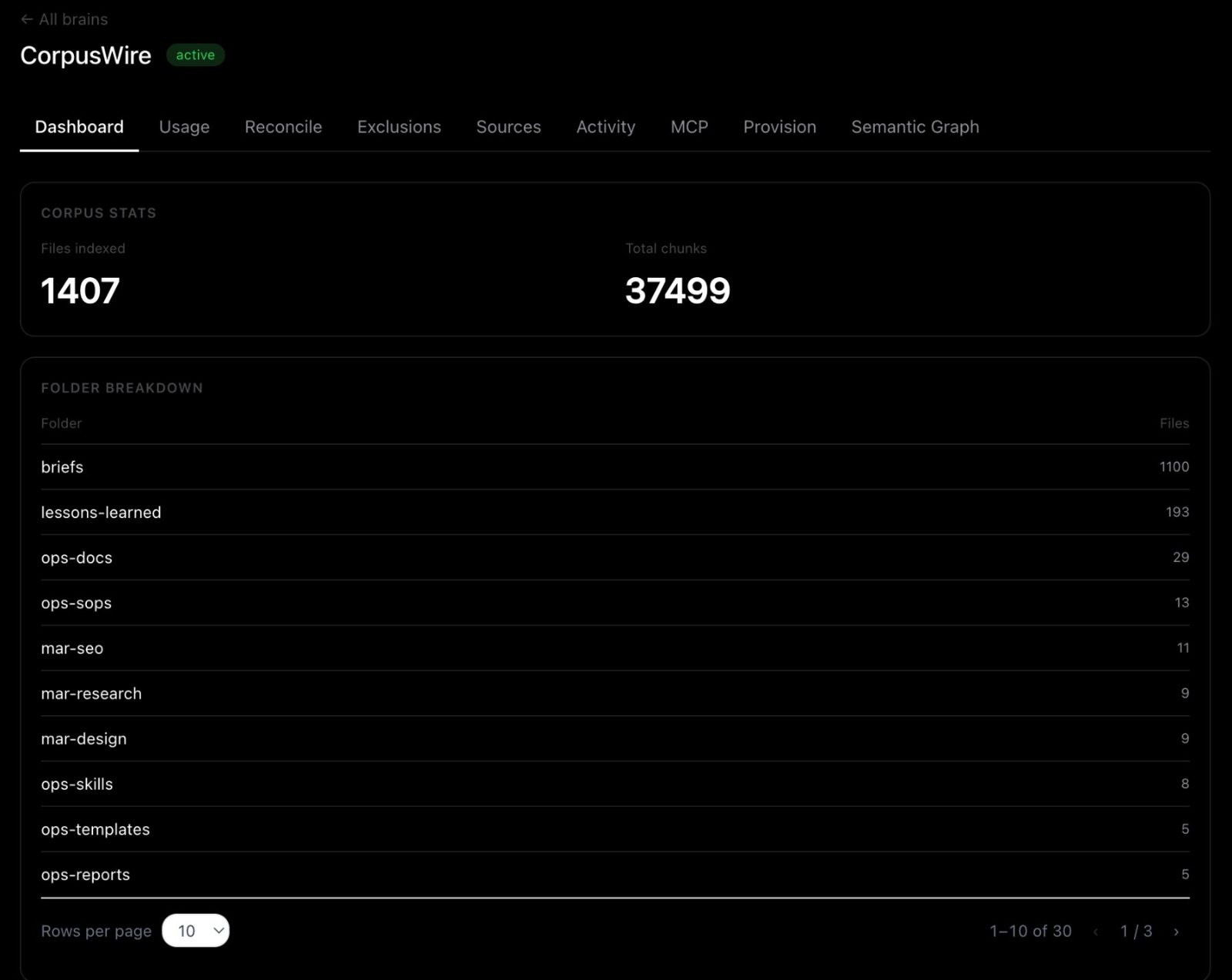
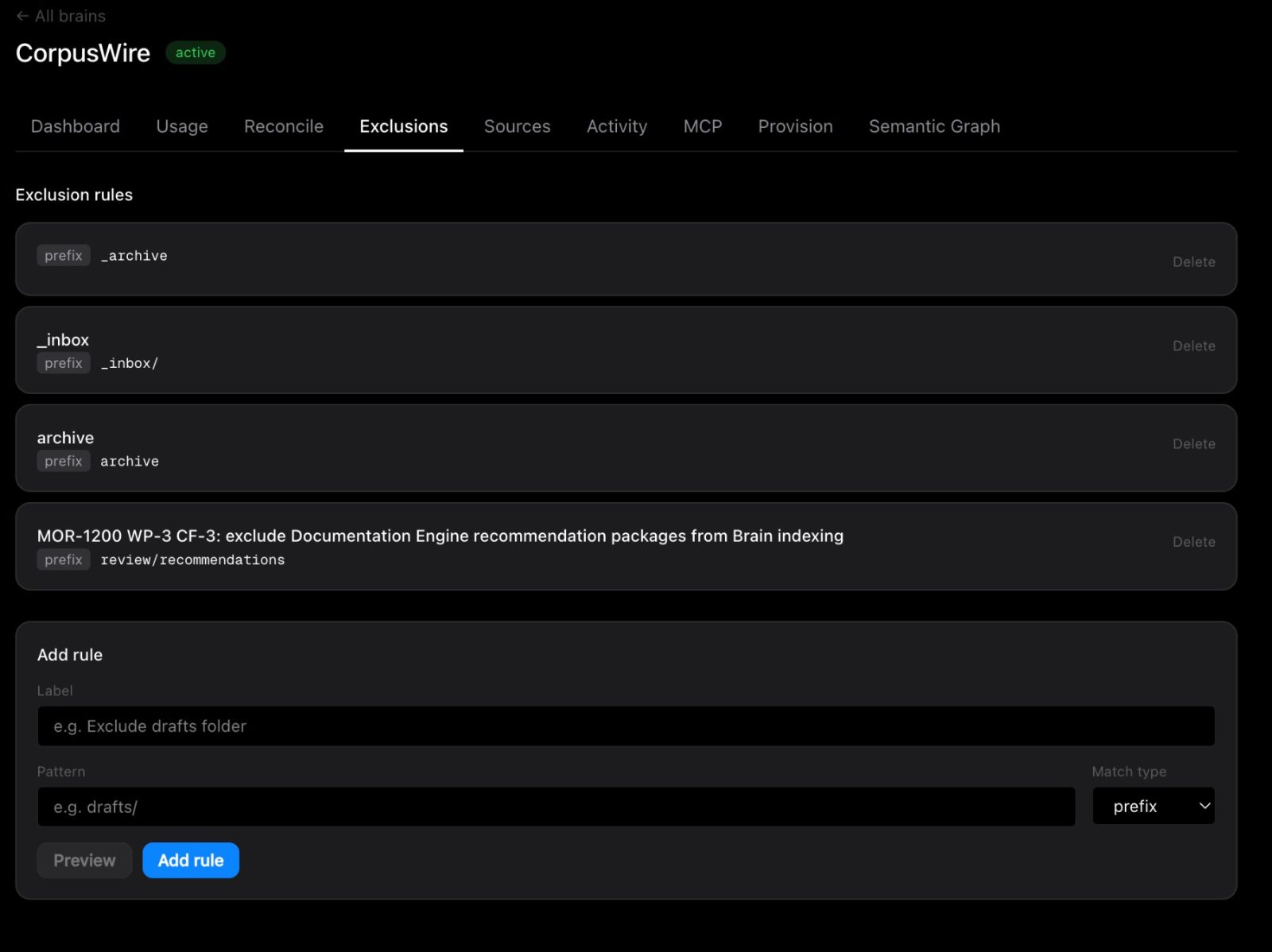
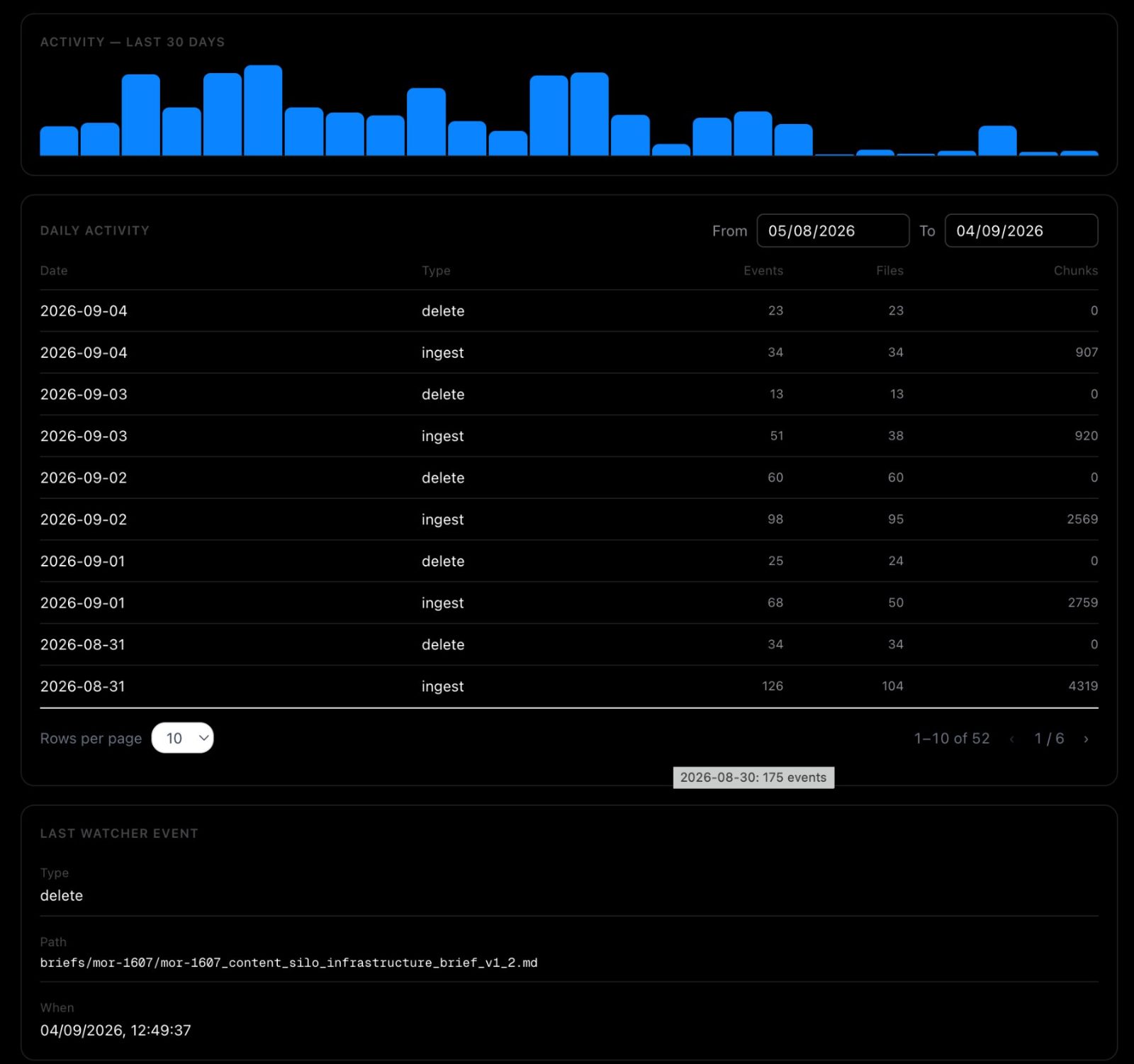
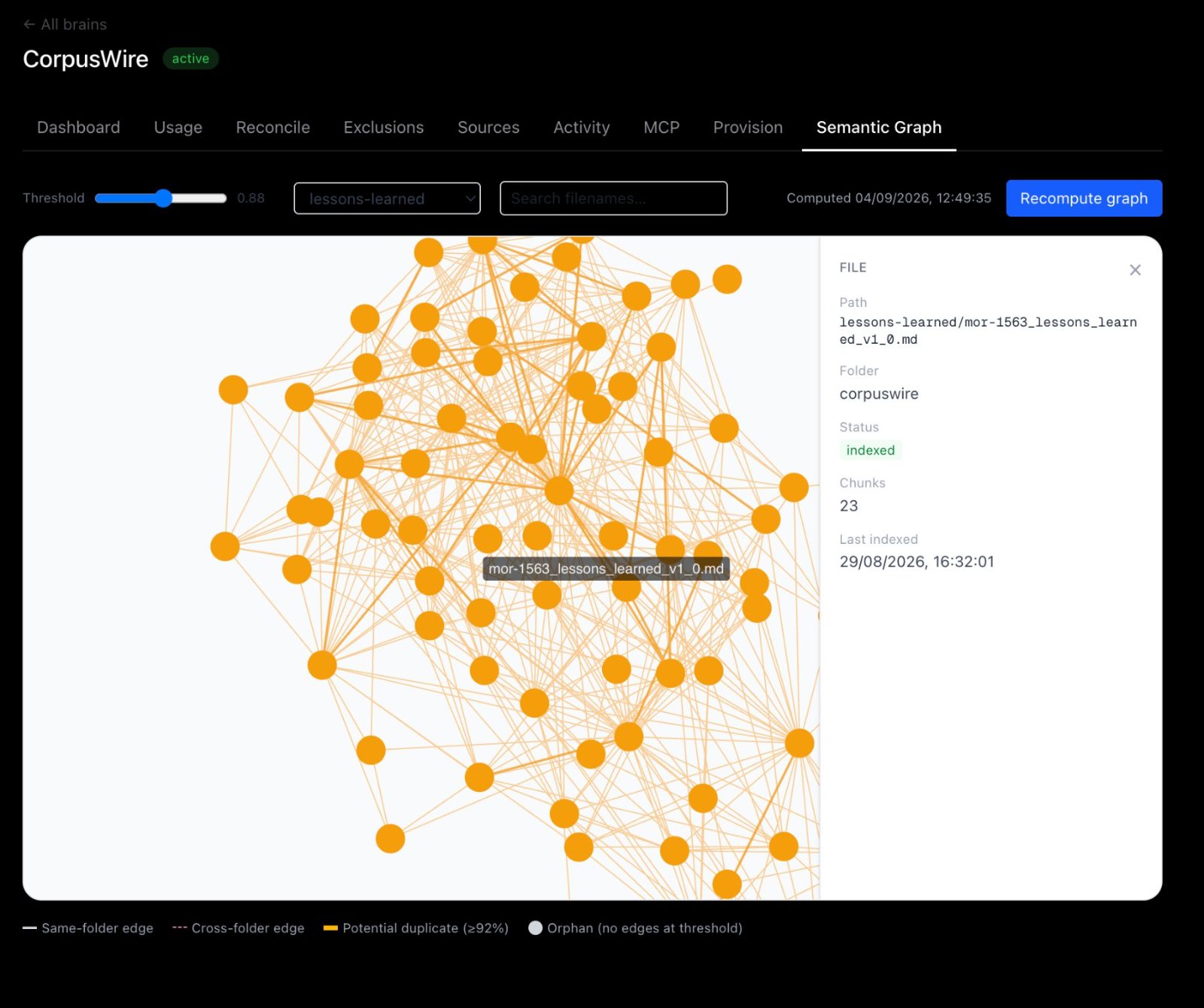
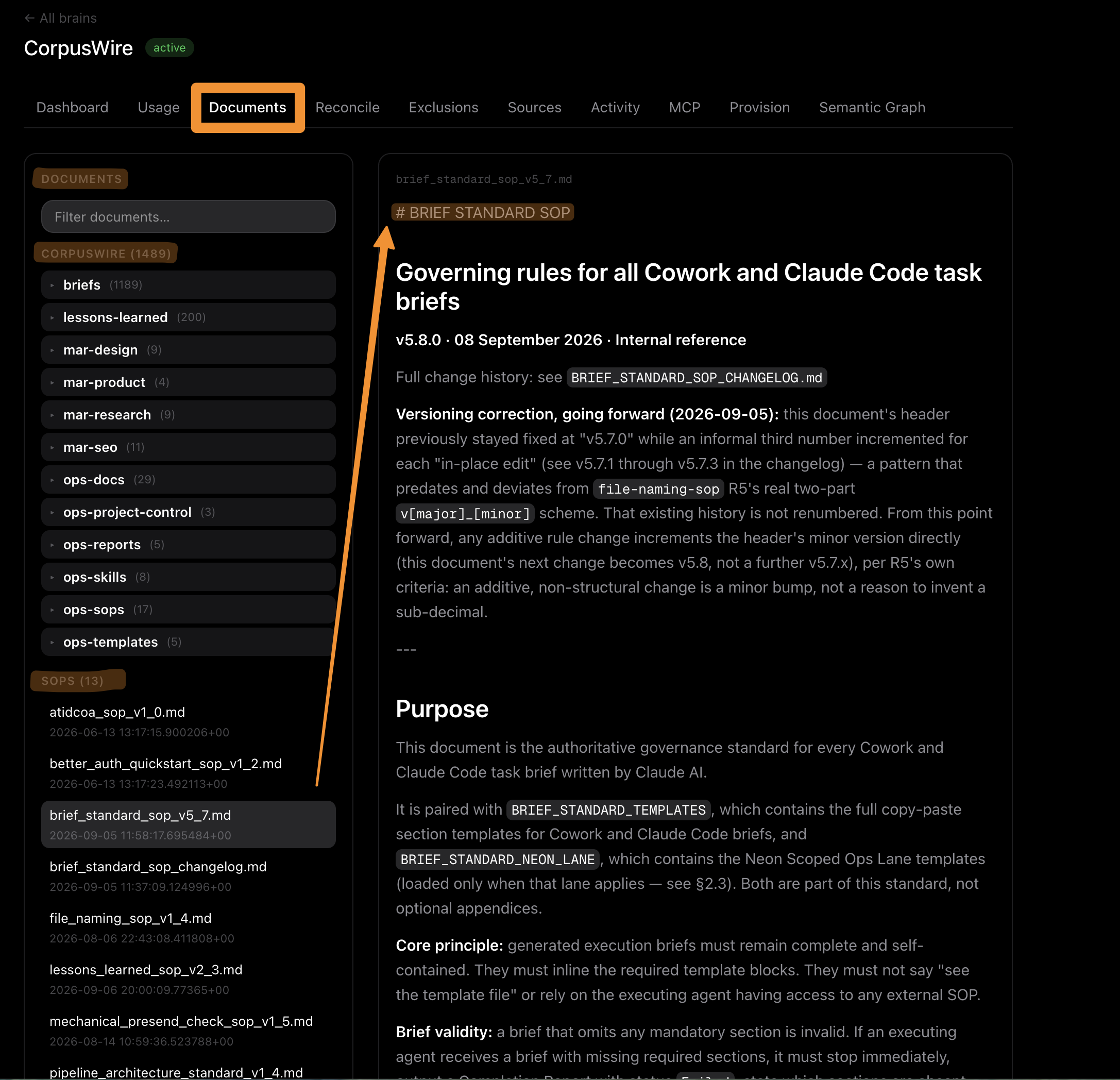
Every brief, every lesson, one wiki.
Nothing your team writes gets buried in a folder again. Every brief, SOP, and lesson learned CorpusWire has ever indexed — browsable, not just searchable.
Three alternatives. One real answer.
The status quo: no intelligence layer at all.
Folders, scattered drives, AI tools used in isolation.
You generate knowledge continuously and almost none of it accumulates.
Every session starts from zero.
Vendor-owned intelligence layers.
They own the index, the retrieval, the upgrade path, and increasingly the pricing.
Your most valuable institutional asset becomes a hosted feature on someone else's roadmap.
DIY engineering build.
You can absolutely build this.
We wrote the guide, and you're welcome to it.
You'll also be building it instead of running your business, maintaining it, and rebuilding it next year when the libraries shift.
Build your own brain, in eight stages →Single-tenant, implemented on your stack.
Your database, your file store, your domain, your data.
MoreResults builds the system for you and maintains it, and it's been on your stack the whole time.
The day you stop working with us, you have a working system, not a logout button.
Nobody told it to check. It checked.
The same bug had cost three PRs and several discovery sessions to track down, the first time it showed up.
The second time, the fix was already indexed in lessons learned.
Claude pulled it on the first try.
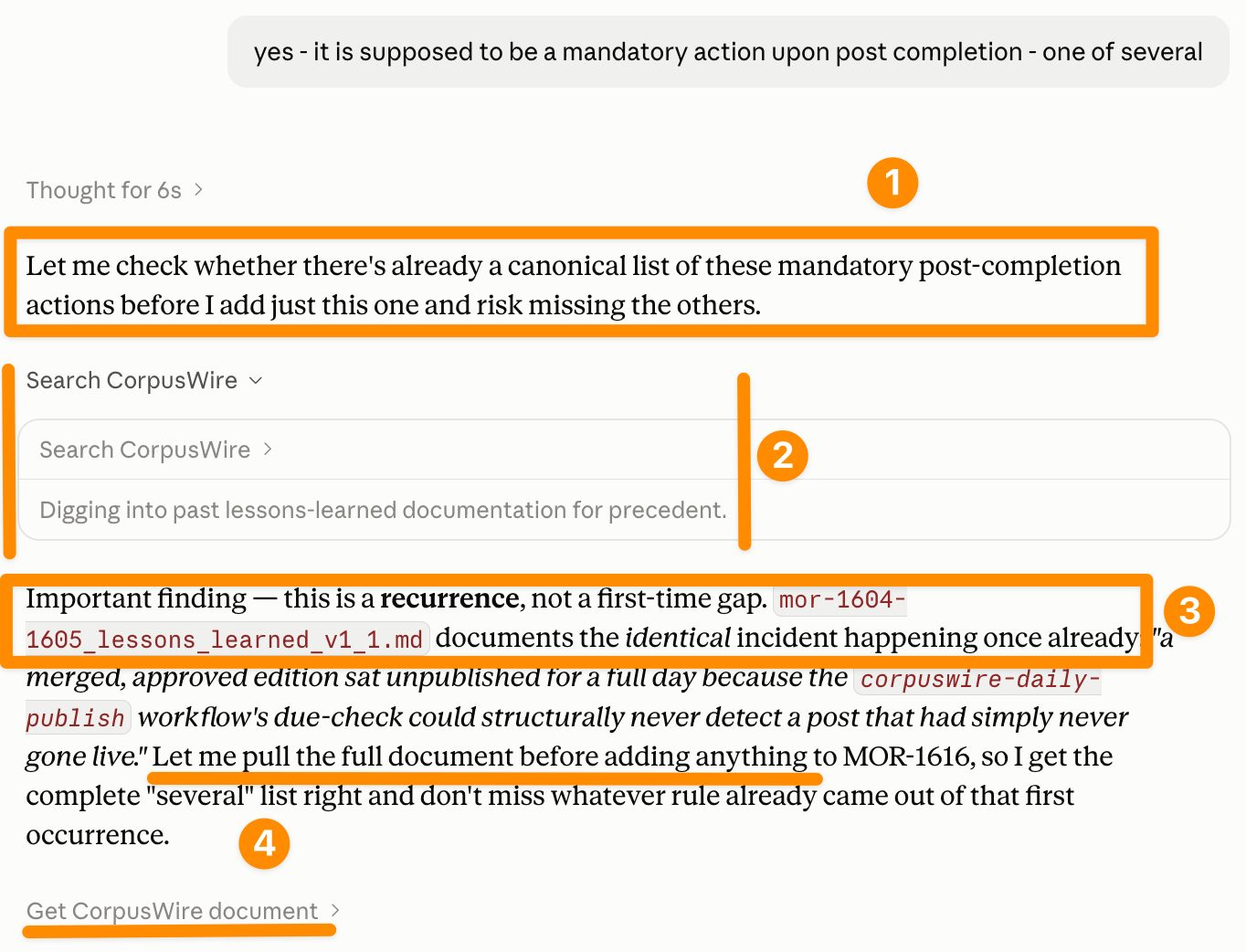
It searches before acting.
Claude searches CorpusWire unprompted and finds a lessons-learned document describing the identical incident.
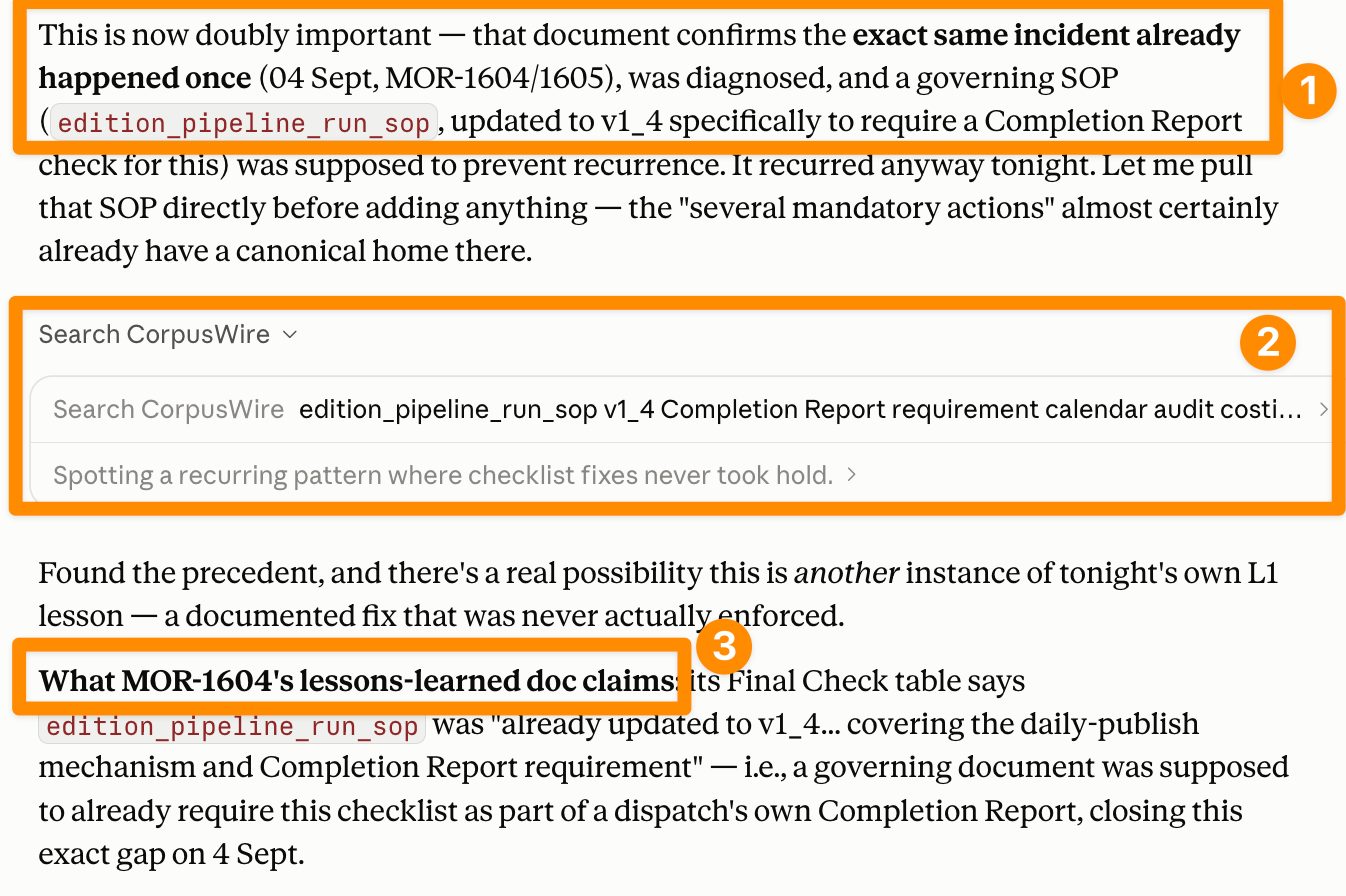
Then it finds the governing SOP that was supposed to have fixed it, and confirms it was documented but never enforced.
View full screenshot →
View full screenshot →
It doesn't stop at the first failure.
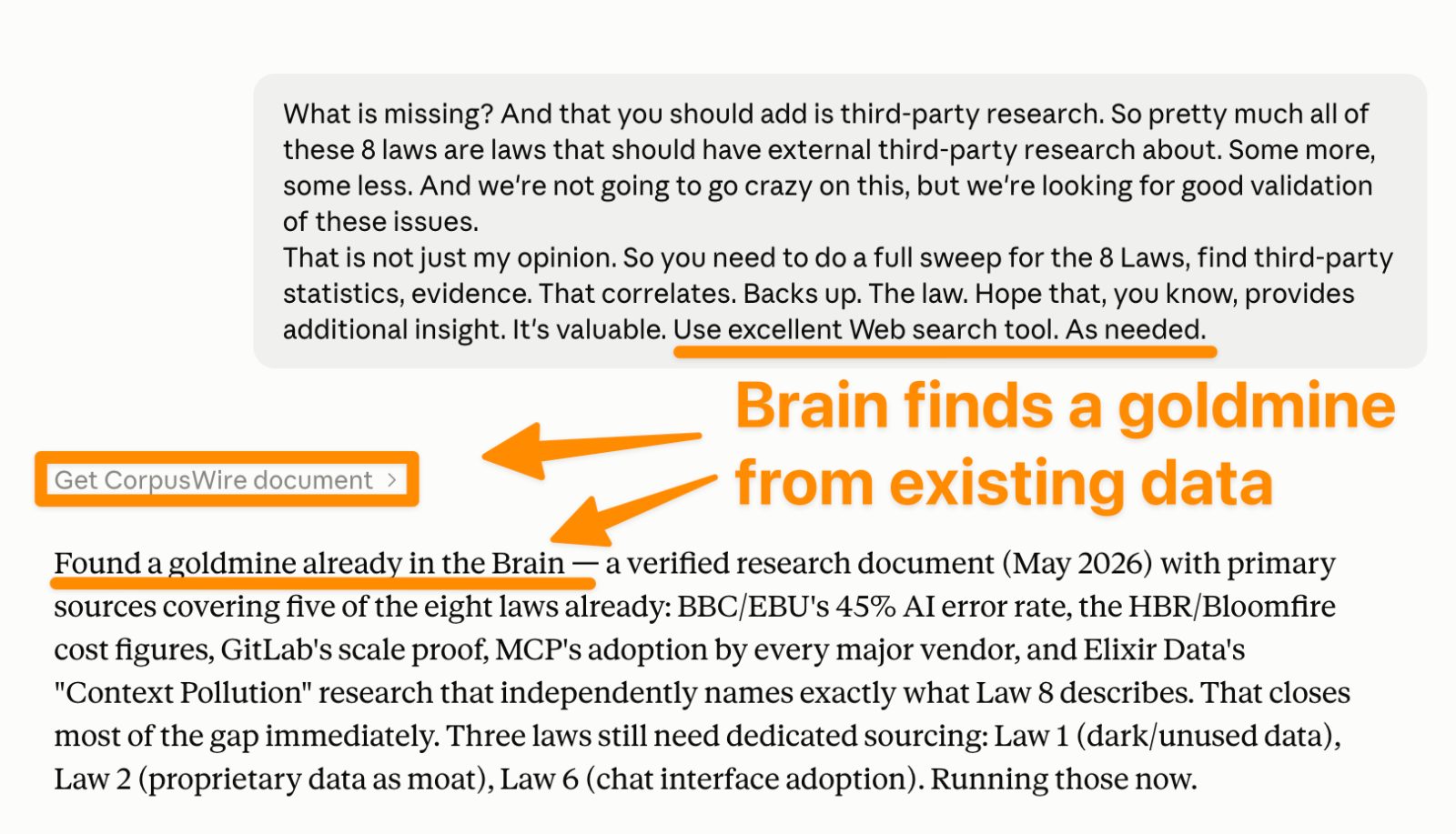
Asked to validate the eight laws against third-party research, Claude searches CorpusWire first and finds an indexed research document covering five of the eight.
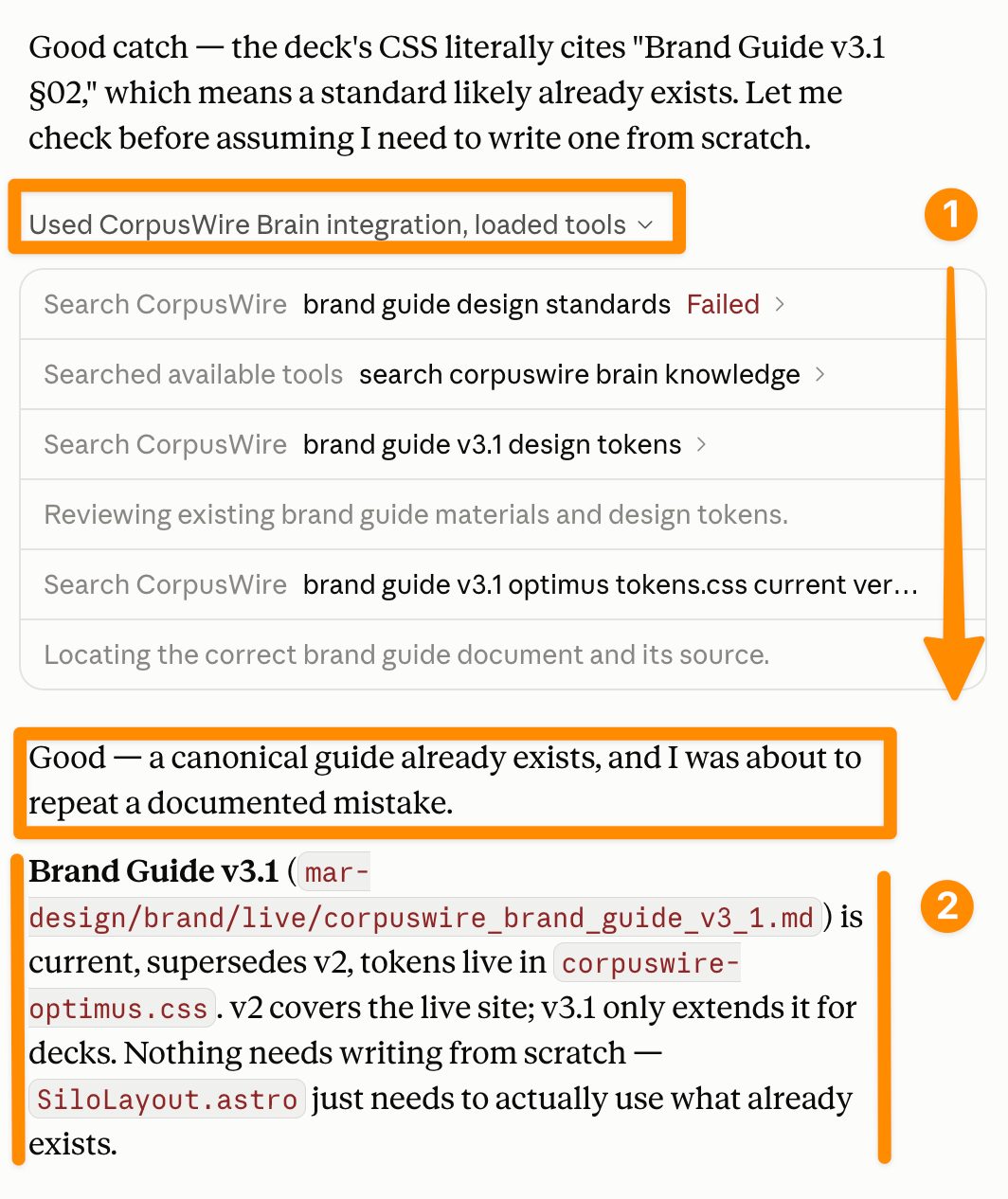
On another task its first search fails, so it runs three more on its own until it finds the canonical brand guide.
View full screenshot →
View full screenshot →
Same corpus. Different model.
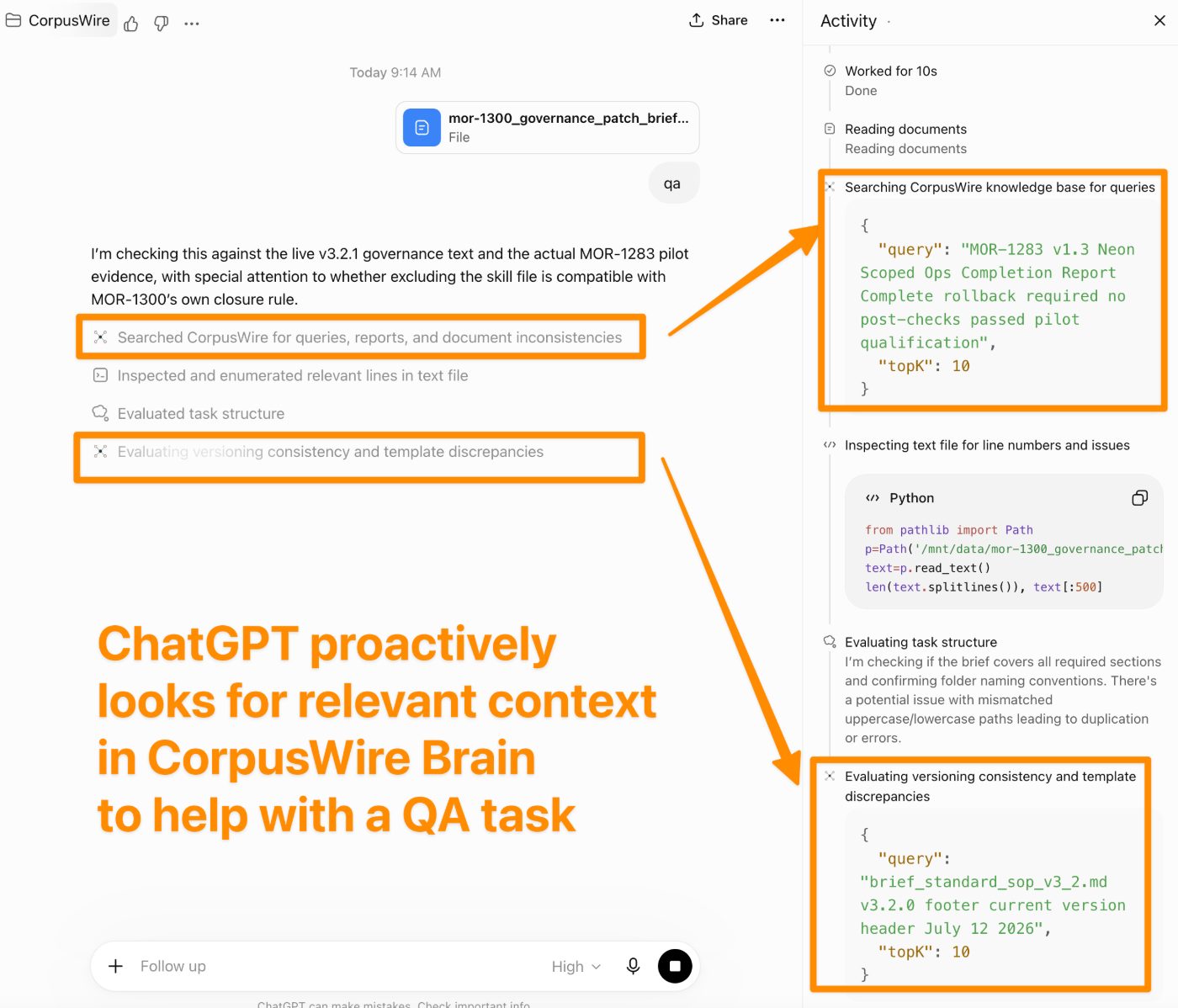
ChatGPT's activity log shows the real CorpusWire search query and parameters.
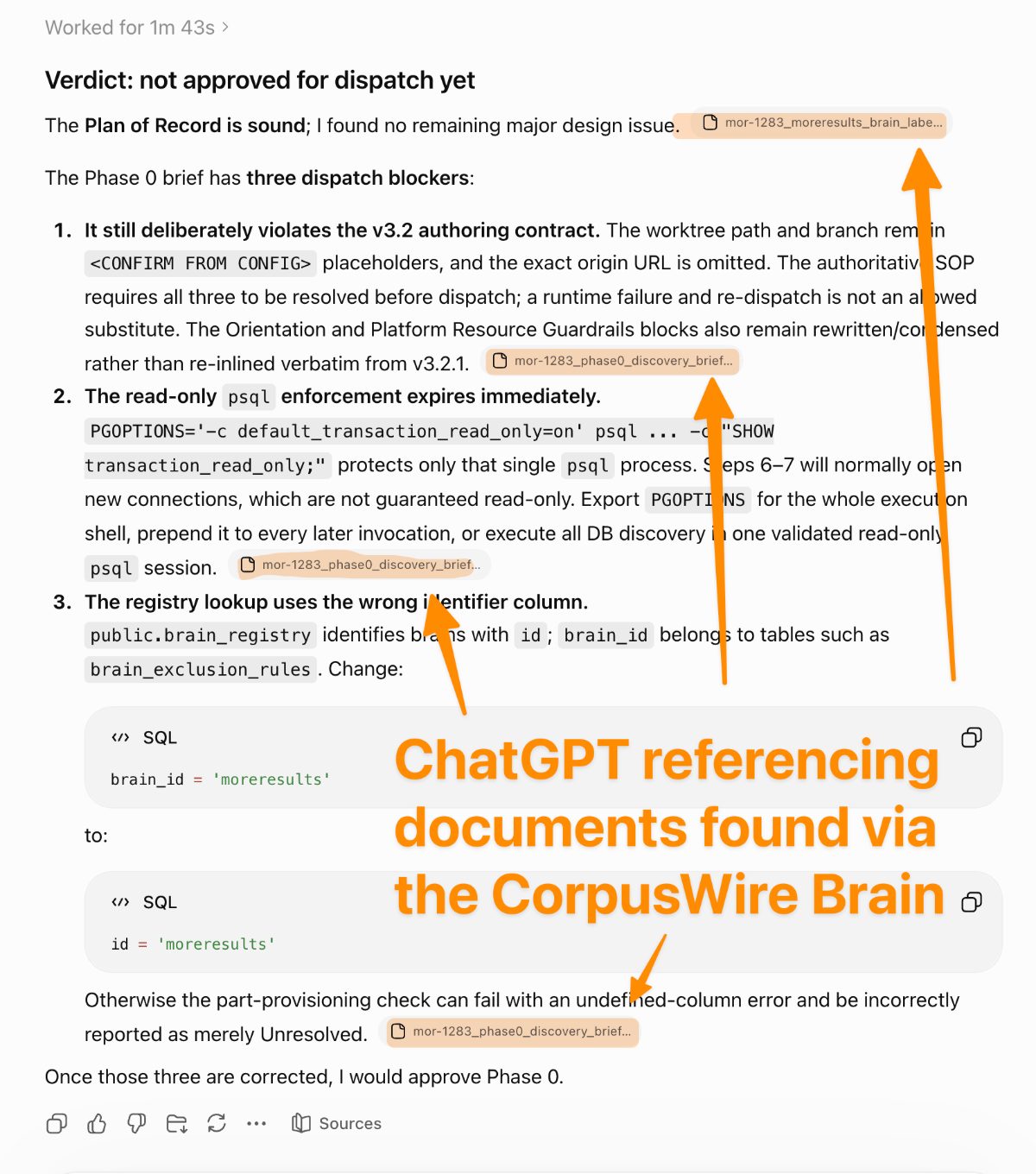
Its QA verdict cites three blocking findings, each traced to a source document.
Only the model changed.
View full screenshot →
View full screenshot →
Stop being the AI's unpaid assistant.
A messy, multi-part question like this usually means untangling it yourself and going to find the answer.
Instead: one word. The AI remembers the brain is there, searches CorpusWire itself, and comes back with the exact source.
Get real-time, accurate answers based on how your business actually operates.
CorpusWire doesn't create new work. It captures the value of the work that was going to happen anyway.
Every project makes the next one easier.
Past decisions, past lessons, past client work, pulled into context automatically.
Your AI gets sharper every week.
Not because the model changed, but because your context did.
Your SOPs stay current.
Generated from real work, kept current as the work changes, available to anyone the moment they need it.
No more documents describing how you used to operate.
Institutional knowledge stops walking out.
Every project closes with its lessons captured.
Every key decision is retrievable months later.
When someone leaves, what they knew stays.
You stop being the bottleneck.
New hires onboard from a working system instead of from your calendar.
Junior team members produce senior-quality work because the context is in the room with them.
The AI tools you already use stop giving generic answers.
Claude, ChatGPT, whatever your team uses.
No new interface to learn.
The difference is the answers come from your business, not the internet.
9 services used. Zero vendor lock-in.
Single tenant owned by design, without structural lock-in.
- Tenant owns the database, source files, code repository, domains, and provider accounts.
- Dropbox and Google Drive both work as the source connector.
- The core data model uses portable PostgreSQL and plain text files.
- Provider changes may require initial reconfiguration.
- Hosting and embedding providers can be changed.
| Service | What it does | Alternative |
|---|---|---|
| Neon | PostgreSQL + pgvector | PostgreSQL-compatible host with pgvector |
| Railway | Worker + auth proxy hosting | Container platform supporting persistent/background services and private networking |
| Vercel | Console + MCP server hosting | Self-hosted Next.js on Node.js or Docker |
| GitHub | Source repo | Any Git-compatible source host with CI/deployment integration |
| Dropbox / Google Drive | Corpus source | Either works |
| OpenAI | Embeddings | Replaceable embedding provider or local embedding model |
| DNS | Domain records | Any DNS provider supporting custom records and TLS |
| mcp-auth-proxy | OAuth/MCP gateway | Open source, replaceable |
| MCP client | Claude, ChatGPT, etc. | Compatibility surface, already demonstrated on this page |
No technical skill required to use it
- Save files to your folders as normal and ask questions inside Claude or ChatGPT, that's it.
- New documents get indexed automatically. No technical tasks required to add knowledge to your corpus.
- The console exists if someone wants to check stats or adjust settings, but it's just an internal web app.
- Minimal and entirely your choice. Support plans available if needed.
Built to survive a single point of failure
- AI provider outages happen but it's rare for them all to go down at once. If one goes down, CorpusWire continues with others and works identically in Claude and ChatGPT.
- Infrastructure (database, hosting) is single-tenant per client, with public status pages and downtime stats.
Common questions.
Yes, because fit is anchored to document volume and AI usage rather than headcount.
If you're regularly producing briefs, SOPs and client correspondence, and your team already uses AI tools daily, the maths works.
Five-to-twenty-five-person knowledge-work businesses are the sweet spot.
The Brain itself is live in 2–3 days, with about two hours of your hands-on time.
The full engagement (scope, install, populate, integrate, train) typically runs 4–6 weeks before steady-state maintenance.
Most of that is mapping how your business actually runs, and very little of it is technical install.
Infrastructure runs about $30–50 a month, billed to your own accounts.
Implementation is bespoke and scoped after a discovery call, in one of the three models described below.
There's no sticker price because the right scope depends on how your business works.
Everything runs single-tenant on your own infrastructure: your database, your functions, your file store.
We never hold your data on our servers.
Authentication and access controls are yours to configure.
The engagement runs in phases, so you see compounding value before implementation completes.
If any phase isn't delivering, we course-correct or stop.
You're never betting everything on a single finish line.
No, the system lives on your stack and the documentation is yours.
Take it in-house, hand it to another implementer, or run it yourself.
That's the whole point of single-tenant: you own the layer.
They already have: project memory, persistent context, saved chats.
Those features lock your knowledge into the vendor's database, behind the vendor's interface, on the vendor's terms.
CorpusWire runs on your infrastructure, so the layer is yours whichever AI tools you happen to be using next year.
Adding knowledge takes no discipline beyond saving files where you already save them.
Indexing is automatic.
The routines that keep an index healthy, exclusion rules, archive handling, periodic review, are ours to run under the support plan, not your team's to remember.
And nothing rots silently: the console shows exactly what is indexed and when it last changed.
Pick how much of it you build.
Do it yourself
Pure consulting.
Your team implements.
We map the system, you build it.
Lowest cost, requires in-house capacity.
Done with you
Consulting plus coaching and support.
Your team builds, we're in it with you, reviewing, unblocking, keeping you on the rails.
Middle ground on cost and ownership.
Done for you
We build it end to end.
You own every account and every credential from day one.
Highest cost, zero build burden.
Models will change again next quarter. Your knowledge layer won't.
Every AI session still starts from zero. Fix that once.
Book a discovery call