Law 4 - The Document Formats Humans Love But AI Hates
Contents
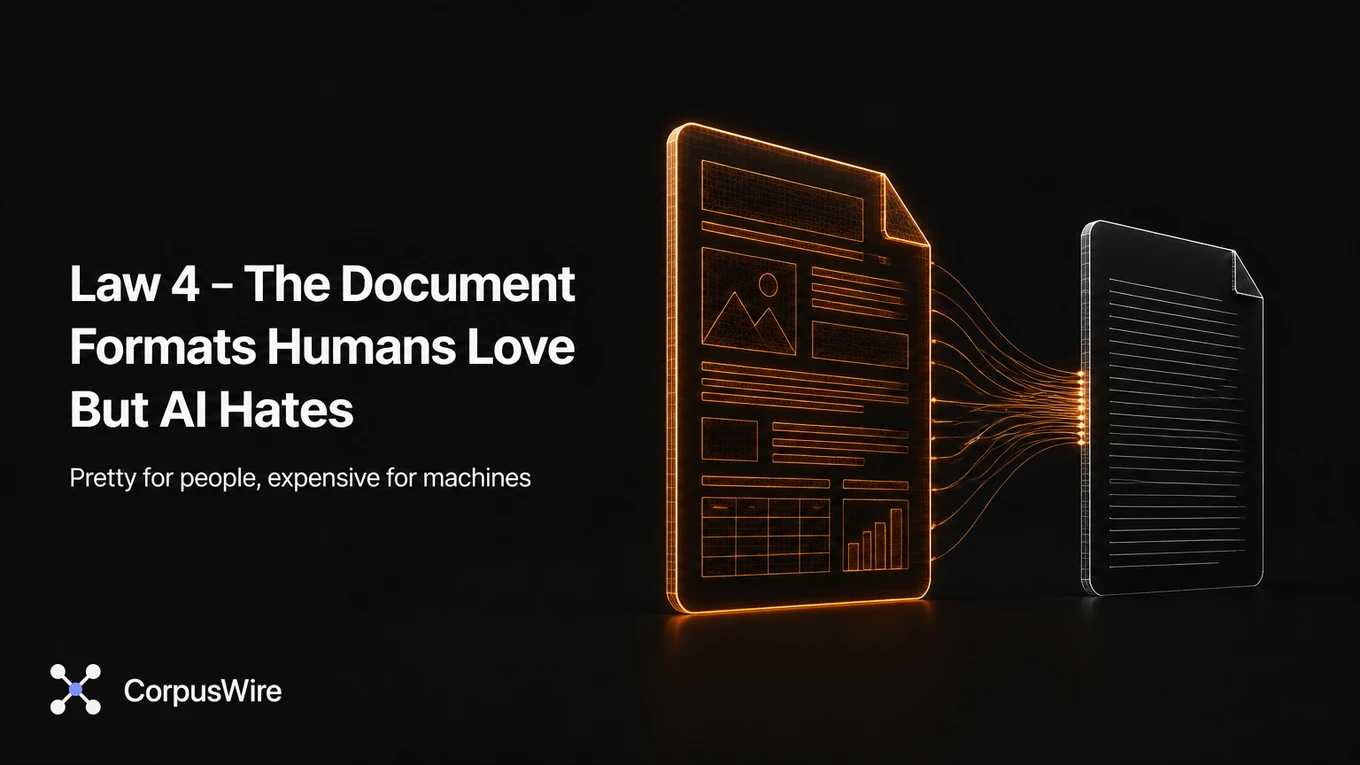
A document built for human eyes is expensive for a machine to act on. The format your team loves is the format your AI works hardest to read.
Documents get created for one of two audiences, humans or AI, and serving both at once is harder than it looks. Humans like Word documents with formatting, colours and fonts. That prettiness is exactly what gets in a machine’s way.
The number: what a plain format buys you
A 2026 comparison of Obsidian, Notion and raw markdown files reached a plain conclusion. Markdown suits anyone who wants long-term control of their own material, because plain text carries no proprietary encoding and both humans and AI read it without conversion.
The cost side is the part almost nobody measures. When a large, heavily formatted PDF or Word file is used as an AI’s source, the system spends real effort just reading it. Reference the same document repeatedly and that cost multiplies on every call.
Visual hierarchy, merged table cells, tracked changes and inline comments are all information a human reads for free and a machine pays to strip out.
Reachable first, then actionable
Actionable means two things. The AI can access the document, and it can use what it finds, which includes acting on it, not just reading it.
Almost any document type can be read once an AI has it. The bigger problem is that it does not have it, or a human has to hand it over every time. A colleague of mine who coaches agency operations puts it the same way: to be actionable a document first has to be reachable, and unreachability is the biggest obstacle.
Once a document is reachable, something else happens. It becomes source material for the next document, and AI is very good at building one thing from another. That is where the compounding starts.
The two-document rule
Machines need simple plain text, and markdown is the most suitable format for that job. A human finds it less pleasant to read, and that is fine, because the human was never the audience for that copy.
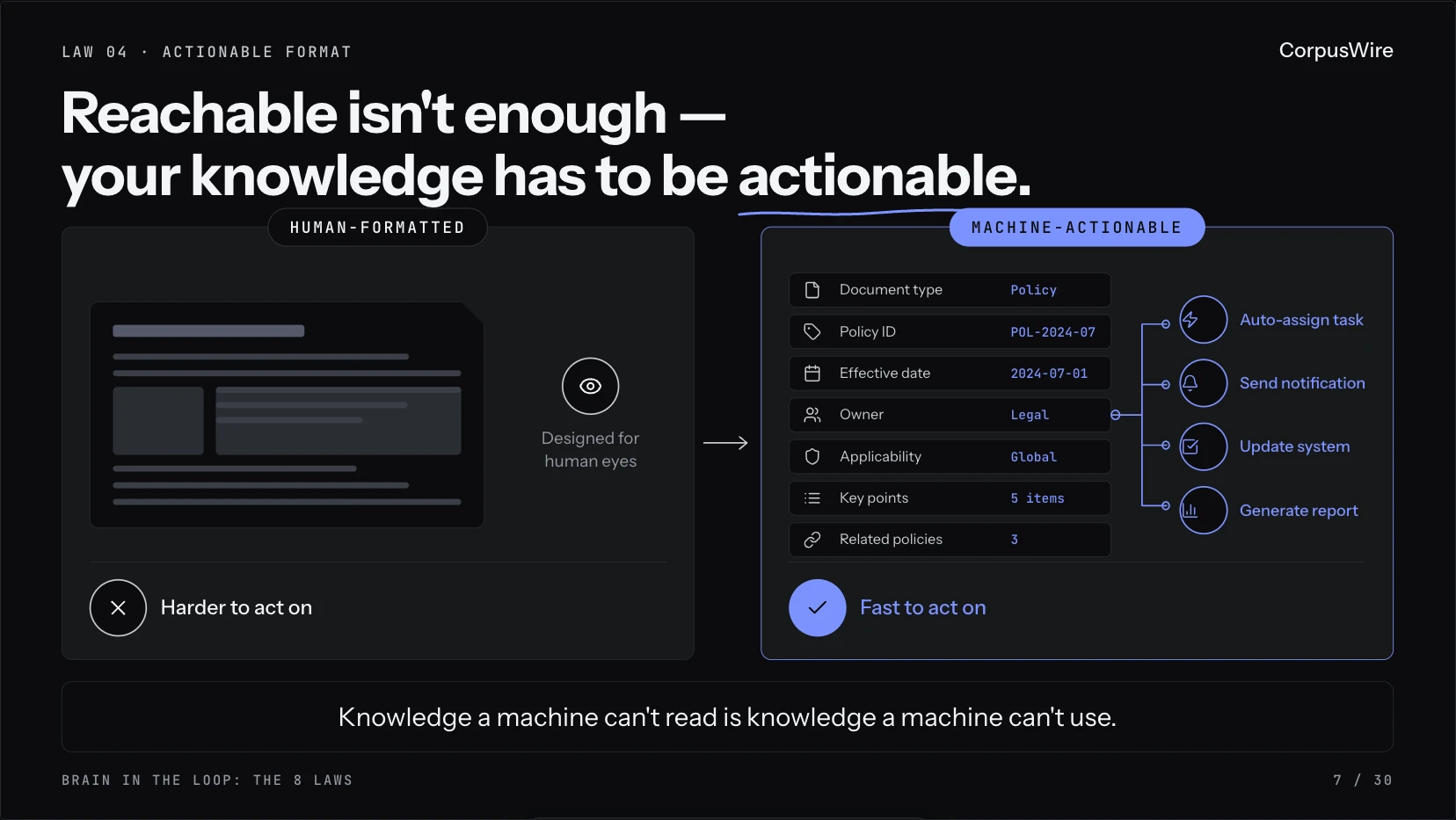
So keep two versions when a document will be used more than once. The human one stays as it is, in Word or PDF, for the people who read it, and the AI’s version is a plain markdown file, smaller, unstyled, and cheap to read on every call.
The honest downside is that two copies are two things to keep in step. The plain one only stays right if it is regenerated when the human one changes, which makes the conversion part of how the document gets updated rather than a one-off favour to the machine.
For a one-off task none of this matters. For an SOP the AI reaches for every day, it shows up on every single call.
The operating layer post makes the same point from the other side: content written for a person skimming behaves badly when a system is extracting one answer at a time.
Why you have never had this conversation
I have never had a client push back on formatting documents for AI, and I doubt you have either. The barrier is indifference, because most people have never considered the question. Once you do, the formatting you added for people starts to look like a tax the machine pays on every read.
So pick the document your team relies on most and ask two things. Can your AI find it without you handing it over, and can it read the whole thing cleanly rather than half of it locked in a layout? Two yeses and it is actionable; anything else and it is readable storage.
FAQ
Do I need to convert my whole archive? No. Start with the documents the AI reaches for repeatedly: the SOPs, the price list, the spec your team works from. A one-off file it reads once can stay as it is.
Who keeps the plain-text copy current? Whoever owns the human version, unless the conversion is automated. The workable pattern is to generate the machine copy from the human one whenever it changes, so nobody has to remember a second edit.
Is this about saving differently, or writing differently? Both. Format decides whether the machine can read cleanly; structure decides whether it can find the answer. A useful sentence buried in paragraph four of a long explanation is easy for a person to skim to and easy for a retrieval system to miss.
Does file size matter? Yes, and it compounds. A heavily formatted file that runs to dozens of megabytes costs effort to read every time the AI references it. The same information in a plain file is cheaper on every call.
What about spreadsheets and slides? Same principle. A spreadsheet’s numbers can be exported to a plain format the AI reads cleanly, and a slide deck’s argument can live in a markdown file next to it. The visual version stays for humans, the plain version does the machine’s work.
This is the fourth of eight laws behind how an AI-native business gets built.