Law 3 - How To Feed Your AI Accurate, Realtime Data So It Doesn't Guess
Contents
Ask an AI about your business and it answers from fragments. Give it your live documents and the same model starts checking instead of guessing.
Nobody needs convincing that AI makes mistakes. Everyone who uses it has watched it get something wrong. What most people miss is why.
Sometimes it fabricates, but more often it is simply guessing, piecing together an answer from scraps of chat history and whatever it can see. The model is trying to be helpful with incomplete data, because that is how it works when nothing better is available.
The number: 45 percent
In October 2025 the BBC and the European Broadcasting Union published a study of 3,000 answers from ChatGPT, Copilot, Gemini and Perplexity. Journalists from 22 public broadcasters in 18 countries graded them. 45 percent had at least one significant issue.
Break that down and 31 percent had serious sourcing problems, and 20 percent had major accuracy errors. One assistant said Pope Francis was the current Pope months after his death. Copilot answered a question about bird flu from a BBC article written in 2006.
Josh Bersin’s reading of the study is the one that matters for a business: any mistake in the corpus can poison every answer drawn from it. His fix is a trusted corpus with named owners and regular audits.
Why the model guesses
The model does not know your clients, your process or your past decisions. It knows its training data and nothing specific to you.
Without that context the system knows nothing about your business. Why would it?
So it reaches for the nearest thing, which means you get the industry standard when you need your specific exception, or a proposal that could belong to anyone.
The partial fixes you have probably tried have a ceiling. Projects and pinned files work until you have to keep them current by hand, and they eat context window and get expensive. In my experience they are not a dependable answer.
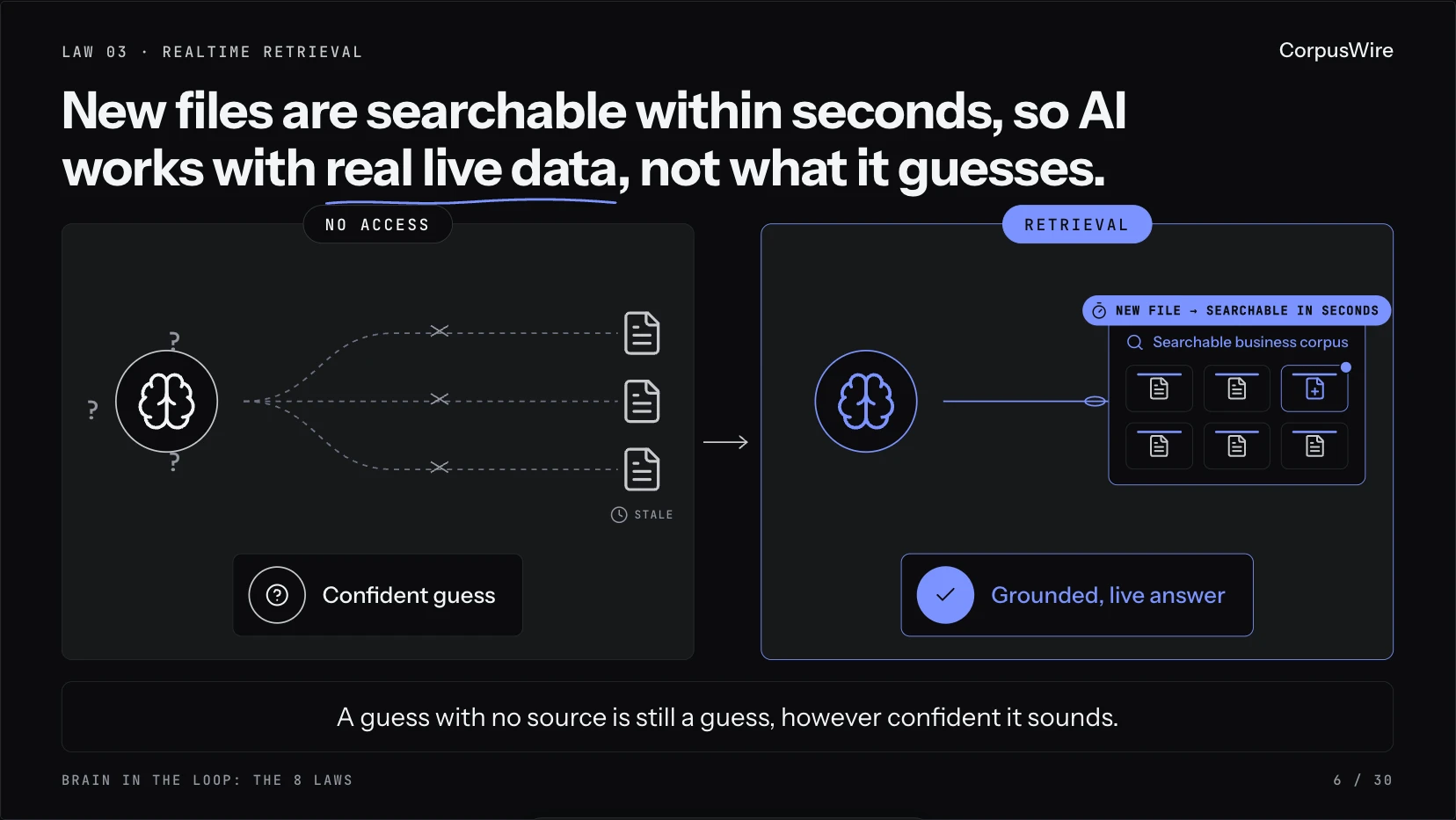
What changes the outcome is giving the model authoritative documents it can query on its own. Then it can locate them, cite them and make a decision with something under it. The post on what RAG actually does walks through the mechanism: one model is guessing, the other is checking.
Why “realtime” is in the title
Retrieval at all is valuable. Slow retrieval is worth far less than retrieval from what is true right now.
In the system I run, a file added to Dropbox becomes searchable within seconds. I watch it happen every day. It is the difference between an AI that knows about the decision you made this morning and one that knows about last month’s version.
Retrieval decides whether the answer is grounded or invented. Realtime retrieval decides whether it is grounded in the current truth or a stale one.
The one-minute test
Next time an AI gives you a confident answer about your own business, ask it one question. “Is this inferred, or is it taken from actual documentation? Show me the source.”
If it can name the document, you have retrieval. If it cannot, you have a fluent guess. You will know within a minute which one you have been trusting.
FAQ
Do I have to retrain the model on my documents? No. Retrieval works at the moment of the question: the system finds the relevant passages and hands them to the model before it answers. Update a document and the next answer reflects it once it is re-indexed, with no training run in between.
What does “searchable within seconds” actually require? Three things. A single source of truth for the files, which for me is Dropbox. Something watching that source and indexing new or changed files into a vector database, and an MCP server so the AI can query the index directly instead of waiting for an upload.
Does this work on meetings and calls, or only written documents? Meetings are the richest source most businesses throw away. Record them, transcribe them, and put the transcripts into the same searchable corpus. Sales teams already do this with sales calls; almost nobody does it for internal meetings.
What should happen when the answer isn’t in my documents? The system should say so. A well-built retrieval setup flags the gap instead of filling it. That honest “I don’t have that” is a feature, and it is the opposite of what an ungrounded model does.
Does realtime retrieval mean the AI is always right? No. It finds the right document more often than not, and I still double-check anything that matters. What changes is that when it is wrong you can see which source it used, so the error is visible and fixable instead of invisible and confident.
This is the third of eight laws behind how an AI-native business gets built.