In the Loop· September 7, 2026
What Is Context Pollution? The AI Problem No One’s Named
Context pollution is what happens when your AI tool pulls from the wrong version of a document.
Duplicate files. Outdated policies still sitting in the drive. Two pricing sheets that disagree with each other.
ElixirData coined the term for exactly this: noise and conflicting information contaminating the context an AI system retrieves from.
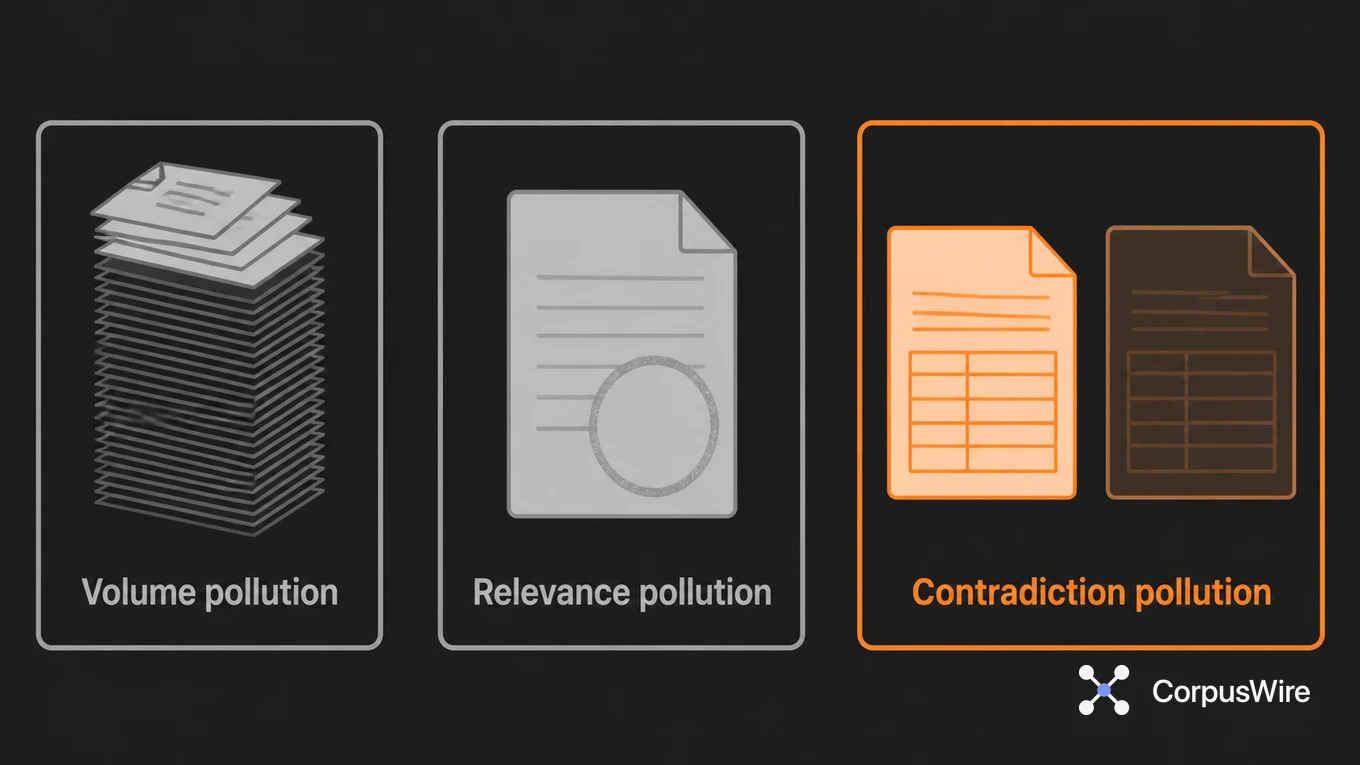
It shows up in three shapes.
Volume pollution: a support agent handed ten thousand touchpoints when only the last three matter.
Relevance pollution: a policy doc that’s technically accurate but describes a process you stopped using 18 months ago.
Contradiction pollution: two versions of the same pricing sheet, both still live, quietly disagreeing.
You filter this instinctively. You know last quarter’s pricing sheet is stale because you remember the update, or you check the date, or you just ask someone.
An AI tool doesn’t have that instinct. Nobody built it one.
Handed everything, it uses everything. It doesn’t get suspicious of a document because it’s old. It doesn’t discount a source because two colleagues stopped trusting it.
That’s why adding more documents can make an AI tool worse, not better. Coverage sounds like a win right up until it includes the wrong answer, filed next to the right one.
A polluted index is worse than no index. That’s the line, and it’s true.
An empty index fails obviously. The tool says it doesn’t know, and a person goes and checks.
A polluted one fails quietly. It answers confidently from the wrong version, and nothing tells you that’s what happened.
The confident wrong answer is the dangerous one. An honest gap, you can catch.
A support agent asks an AI tool what the refund policy is, on an ordinary Tuesday, nothing unusual about the question. The tool finds three documents that mention refunds: the current policy, a macro someone wrote for a one-off exception in March, and a page from the old handbook nobody archived.
It blends all three into one confident answer. The customer gets told something that’s technically sourced and practically wrong.
Nobody has to make a mistake for that to happen. The documents were all real, and the retrieval worked exactly as designed.
The pollution was already sitting in the index before the question got asked. That’s the part that’s easy to miss when you’re auditing for errors instead of auditing for stale copies.
The fix is fewer, cleaner sources. Deduplication before ingestion, so two copies of a document don’t count as two independent facts. A quality gate that keeps superseded versions out of the same retrievable pool as the current one.
That means a document store needs a real notion of “current version,” one the retrieval layer actually respects. Not a folder where the newest file just happens to be whatever someone dragged in last.
A quality gate is what enforces that notion at ingestion, not after the fact. It checks a new document against what’s already indexed on the same topic, flags the overlap, and either supersedes the old version or asks a person to confirm which one stays live. Skip that check and you’re back to hoping the newest file wins by accident.
Onboarding checklists are the clearest case. A new hire’s checklist gets revised every time a tool changes or a step gets cut. The old copy rarely gets deleted, it just stops being the one anyone opens on purpose.
An AI tool doesn’t know it stopped being the one. It’ll happily hand a new hire the version from two reorgs ago, right alongside the current one, and let them figure out which steps still apply.
It’s a small, survivable version of the same failure, easy to shrug off with an onboarding checklist. Scale it up to a pricing sheet or a compliance policy, and “figure out which steps still apply” stops being an acceptable answer.
None of this is a one-time setup. Worth saying plainly, because it’d be easy to sell it that way.
What counts as relevant shifts as the business does. A policy current in January can be June’s pollution source, the moment a new version replaces it somewhere the old one’s still reachable.
That ongoing discipline is what most AI rollouts skip. It’s usually why a tool that looked sharp in the pilot, back when the document set was small and somebody had just cleaned it up, gets noticeably vaguer six months later. Sometimes just wrong.
One honest limit: fixing this doesn’t remove every judgment call. Whether a document counts as superseded or just older-but-still-valid is still a human decision more often than not.
Deduplication and quality gates cut how often you have to make that call. They don’t make it for you.
FAQ
Is context pollution the same thing as an AI hallucination? No. A hallucination is the model inventing something with no source. Context pollution is different: every fact cited is real, just the wrong version or sitting next to a contradicting one.
How do you actually find context pollution before it shows up in an answer? Look for the same topic covered by more than one live document with different last-modified dates. Then check whether the older one is still reachable by the AI tool’s search, not just archived somewhere in theory. A corpus with no version control on its retrieval layer will keep surfacing both, indefinitely. Pick five topics your team asks about often, and count how many source documents exist for each one right now.
Does deleting the old file fix it, or does the AI tool still remember it? Deleting the file only fixes it if the retrieval layer’s index gets updated too. A file removed from the drive but never re-synced to the index is still fully retrievable, sitting in the same pool as everything current, until the next ingest run catches the deletion.
Is this only a problem for large companies with huge document sets? No. A team of five with two conflicting versions of one pricing sheet has the exact same failure mode as an enterprise with ten thousand documents. Volume makes it more likely, but a single stale copy sitting next to the current one is enough to produce a confidently wrong answer.
Want this running inside your own org?
Happy to show you how this fits your setup. 30-minute call, your documents, no prep needed.
Book a call →