In the Loop· August 26, 2026
RAG vs. agentic AI: what’s the real difference
Contents
Here’s the direct answer. RAG is a retrieval technique: it decides where an AI system’s facts come from. Agentic AI is an autonomy pattern: it decides what the system does next.
RAG is a data layer, agentic is a control layer, and most systems worth building use both. Picking between them is usually the wrong question.
Why everyone mixes these up
Both terms exploded at the same time. Both get attached to the same products. Both show up in the same vendor decks, often in the same sentence, meaning whatever the slide needs them to mean.
So teams end up asking “should we do RAG or agentic AI” as if it’s Postgres vs. MySQL. A choice between two things that do the same job.
It isn’t. The two answer completely different questions.
RAG answers: when the model speaks, what is it allowed to know?
Agentic answers: when the system runs, who decides the next step?
You can have either one without the other, or both. The confusion comes from comparing a knowledge mechanism against a behaviour mechanism, which is a bit like comparing your filing system to your project manager.
What RAG actually does
RAG, retrieval-augmented generation, bolts a search step onto a language model. Before the model answers, the system retrieves the most relevant chunks from your own document corpus and hands them to the model as context. The answer comes back grounded in your actual documents instead of the model’s training data.
That’s the whole trick, and it solves a specific problem: models are fluent about everything and accurate about nothing in particular. Ask an ungrounded model about your refund policy and it will produce a confident, plausible, invented one. That failure mode has a name, hallucination, and RAG exists to close it.
If the mechanics are still fuzzy, the plain-English RAG guide covers them properly. For this post, hold onto one thing: RAG is passive.
It doesn’t decide anything. It fetches, it grounds, it answers. One question in, one sourced answer out.
What agentic AI actually does
Agentic AI describes systems where the model doesn’t just answer. It acts.
An agent gets a goal, not a question. It breaks the goal into steps, picks tools to execute those steps, looks at what came back, and decides what to do next.
Search this, then read that, then draft this, then check the result. A loop, with the model in the driver’s seat.
The defining feature is the decision loop. A plain chatbot runs one lap: prompt in, answer out. An agentic system keeps running laps until the goal is met or it gives up, and it chooses the route itself.
That’s powerful, and it’s also exactly why agentic systems are harder to trust. Every extra decision the system makes on its own is a decision nobody reviewed. Autonomy without grounding is how you get a very industrious system doing confidently wrong things at scale.
The difference in one sentence
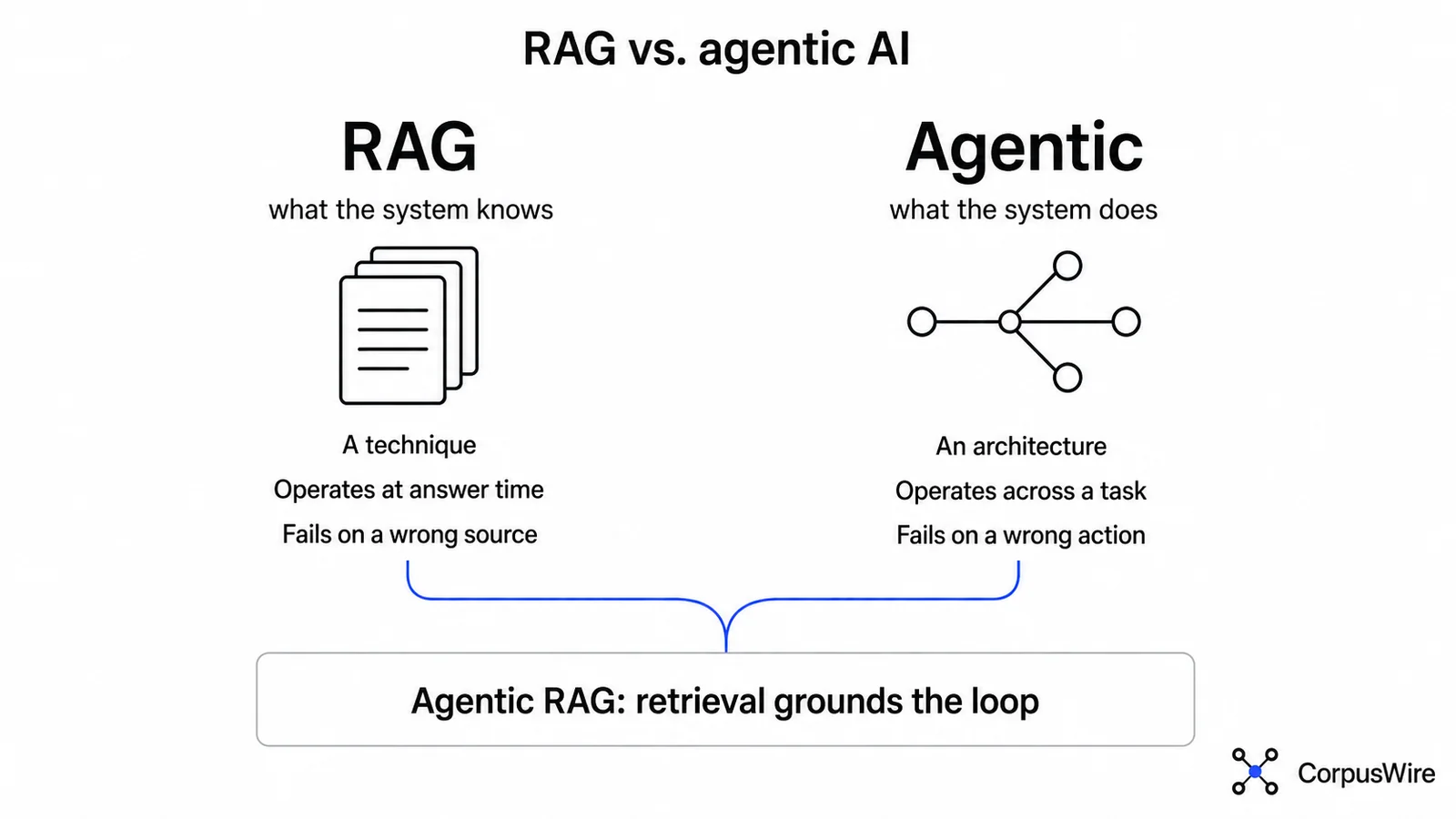
RAG governs what the system knows. Agentic governs what the system does.
Put them side by side and the false choice disappears.
RAG is a technique. Agentic is an architecture.
RAG operates at answer time. Agentic operates across a whole task.
RAG’s failure mode is a wrong or missing source. Agentic’s failure mode is a wrong action.
RAG makes a model honest. Agentic makes a model useful for work that takes more than one step.
Different layers. Different jobs. Different risks.
Where they meet: agentic RAG
In practice they strengthen each other.
An agentic system needs tools, and for any system that works over documents, retrieval is the most important tool it has. An agent that can query a well-built corpus doesn’t guess what your contracts say. It looks them up, mid-task, as many times as the task needs, and every answer it builds traces back to a real source.
This pairing has a name, agentic RAG, and it’s less exotic than it sounds. The agent runs the loop. RAG grounds every step of it.
The retrieval layer keeps the autonomous layer honest.
That’s the architecture CorpusWire is built around: the Brain is the grounded retrieval layer, exposed so agents can query it as a tool. The agent side keeps evolving fast. The layer that decides what the agent is allowed to treat as true is the part you own, and the part worth building properly first.
Which one you actually need
Start with the question you’re really asking.
If your problem is “our AI makes things up about our own business,” you need RAG. That’s a grounding problem, and no amount of agentic sophistication fixes it. An agent without grounding just hallucinates with extra steps.
If your problem is “answering questions isn’t enough, we need work done,” you need agentic behaviour. And the first thing that agent needs, before it touches anything real, is a trustworthy retrieval layer to reason from.
That’s why you almost always build the grounded layer first. Retrieval quality is measurable, improvable, and durable.
Agent frameworks keep churning. A clean, well-indexed corpus outlives all of them, and every future agent you adopt gets smarter the day you plug it in.
Get the knowledge layer right and the autonomy layer becomes a choice. Get it wrong and the autonomy layer becomes a liability.
FAQ
Can a system be both RAG and agentic? Yes, and the best document-focused systems are. The pattern is usually called agentic RAG: an agent plans a multi-step task and uses retrieval as a tool at each step, querying a grounded corpus whenever it needs facts. The agent supplies the autonomy, RAG supplies the truth, and neither replaces the other because they operate at different layers.
Do I need agentic AI to get value from RAG? No. A plain RAG setup, one question in, one grounded answer out, is enough to stop a model inventing facts about your business, and it’s where most teams should start. Agentic behaviour becomes worth adding when answers alone stop being enough and you need multi-step work carried out.
Want this running inside your own org?
Happy to show you how this fits your setup. 30-minute call, your documents, no prep needed.
Book a call →