In the Loop· August 20, 2026
RAG meaning: retrieval-augmented generation explained for operators, not ML engineers
Contents
RAG stands for retrieval-augmented generation. It’s a way of running an AI model that pulls real documents into the conversation before it answers, instead of relying only on what it memorized during training.
A plain language model generates the most statistically likely response from its training data. A RAG system does something different. It retrieves the specific passages relevant to your query first, then generates an answer grounded in what it just retrieved.
The difference sounds small. It isn’t. One model is guessing, the other is checking.
If you’ve read “what is RAG in AI” or “retrieval augmented generation” and come away more confused, that’s usually because the explanations are written for people building the retrieval pipeline. Not for people deciding whether to use one. This post skips the vector math and covers what RAG actually changes for a team running document-heavy operations.
Why RAG exists
Large language models have two structural problems.
First, their knowledge is frozen at training time. They don’t know about the contract you signed last week or the policy your team updated yesterday.
Second, when a model doesn’t know something, it doesn’t reliably say so. It produces a fluent, confident-sounding answer anyway, because generating plausible text is the only thing the model actually does. That’s what people mean when they say a model hallucinated.
RAG addresses both problems at once. Because the model retrieves current documents before answering, it isn’t limited to whatever was true when it was trained. And because it’s generating from retrieved text rather than from memory alone, it has something to point back to: a specific passage that can be checked, instead of an unverifiable claim pulled from billions of parameters.
The research backs this up. In a 2021 study on knowledge-grounded dialogue, researchers at Facebook AI Research found that adding a retrieval step in front of generation substantially reduced hallucination, confirmed through human evaluation rather than automated metrics alone. The mechanism is simple: retrieved text gives the model an external ground truth to copy or paraphrase from, rather than a blank page it has to fill from pattern-matching alone.
How it actually works, in three steps
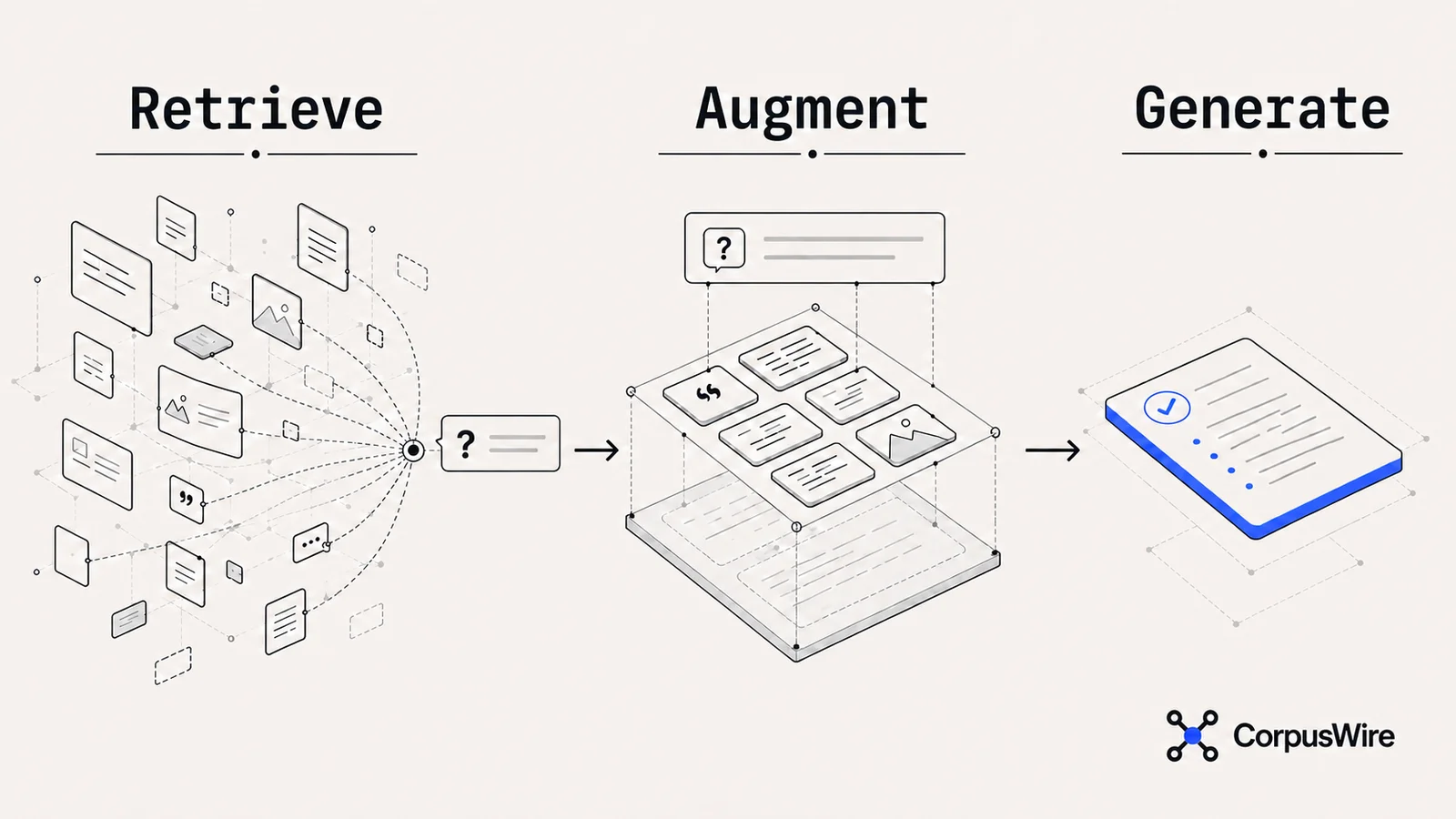
Strip away the infrastructure and RAG is three steps, repeated on every query:
- Retrieve. Your question gets converted into a form the system can search with. It pulls back the most relevant chunks from your document set, not the whole document, just the passages that actually match.
- Augment. Those passages get added to the prompt alongside your original question, so the model has real source material in front of it before it starts generating.
- Generate. The model writes its answer using both your question and the retrieved passages, ideally drawing directly from what it was given rather than inventing from scratch.
None of this requires retraining the model. That’s the operational point most technical explanations skip: RAG feeds a model better inputs at the moment of the question, not new facts permanently.
Update the underlying documents and the next query reflects the change, once the system has re-indexed them. No fine-tuning run. No waiting for a new model version. This is the same indexing mechanism Build Your Own Brain walks through in more detail: how retrieval actually gets built on top of a document set.
What RAG changes for a real team
For an operator, not an ML engineer, three things matter more than the architecture diagram.
Your answers come from your documents. A RAG system built on your contracts, your SOPs, your support history answers from that material specifically, not from whatever the model absorbed from the public internet. Ask it about your own refund policy and it should quote your refund policy, not improvise one that sounds plausible.
It updates the moment your documents do. Change a policy, upload a new spec, correct an error in a procedure doc. A properly indexed RAG system reflects that on the next query. There’s no retraining cycle standing between “we fixed the document” and “the AI knows the fix.”
It can show its work. A well-built RAG system can tell you which documents it pulled from to build its answer. That’s not a minor feature.
You’re not trusting the AI because it sounds right. You’re trusting it because you can check the source it actually used.
A concrete example
Say a customer asks your support team, “What’s your policy on late deliveries?”
Without RAG, an AI assistant answers from general training data. Plausible-sounding logistics-industry boilerplate that may have nothing to do with what your company actually promises.
With RAG pointed at your actual policy documents, the system retrieves the specific late-delivery clause from your terms of service. It feeds that to the model alongside the question and generates an answer built from the exact text. Update the policy next quarter and the answer changes the next time the system re-indexes that document, because it’s reading the current version, not a snapshot frozen at some earlier training date.
The same pattern holds internally. An engineer asking “what’s our incident escalation process” gets an answer sourced from the actual runbook, not a generic best-practices summary. A new hire asking about expense policy gets the current policy, not whatever version happened to be public when a general-purpose model was trained.
That’s the real value. Not that the AI sounds smarter, but that the answer traces back to something real, and stays current without anyone retraining a model.
What RAG is not
RAG is not fine-tuning. And it’s not a replacement for having your documents in order in the first place.
A retrieval system is only as good as what it’s retrieving from. Messy, contradictory, or outdated source documents produce messy, contradictory, or outdated answers, just with more confidence behind them.
RAG doesn’t fix bad documentation. It surfaces it faster.
It’s also not the same thing as an AI knowing your business the way a long-tenured employee does. RAG retrieves and grounds. It doesn’t reason about what wasn’t written down.
If the answer to a question isn’t in your documents, a well-built RAG system should say so, not fill the gap with something that sounds close enough.
Where it fits in the bigger picture
RAG is one layer of what’s often called an operating layer for a company’s knowledge: the thing that sits on top of a document corpus and makes it queryable in plain language, instead of requiring someone to already know which folder to search.
On its own, retrieval and generation solve the “give me an accurate answer from my documents” problem. How documents get indexed, how permissions get handled, how the system stays current as new documents arrive: that’s a bigger conversation than retrieval alone. But RAG is the mechanism that makes the plain-language answer possible in the first place. That’s the framing behind treating documents as data: raw source material that has to be indexed and kept current before retrieval can work at all, not a filing-cabinet afterthought.
That layer needs more than retrieval and generation alone to stay trustworthy. Documents have to be indexed as they’re created, not batch-uploaded once and left to go stale. Permissions need to travel with the source material, not get bolted on as an afterthought.
A RAG system built on a document set that nobody’s kept current will answer confidently from stale information, the same failure mode it’s supposed to fix. Retrieval only helps if what it’s retrieving from is actually current.
FAQ
Is RAG the same as fine-tuning? No. Fine-tuning changes the model’s internal parameters through additional training. It’s slow, needs technical resources, and the model still can’t cite exactly where an answer came from. RAG leaves the model itself untouched. It retrieves relevant documents at the moment of the question, then generates from those. Fine-tuning teaches a model general patterns. RAG gives it something specific to read before it answers. Many production systems use both, but they solve different problems. RAG is often the faster, cheaper starting point for making an AI system answer accurately from a specific body of documents.
Does RAG eliminate hallucination completely? No system eliminates it completely. But retrieval substantially reduces it by giving the model real source material to ground its answer in, rather than generating purely from memory. The remaining risk shifts from “the model invented a fact” to “the retrieval step missed the right document.” That’s a different, more fixable problem. It’s about search quality and document coverage, not the model’s underlying behavior.
Do I need a vector database to build RAG? Most production RAG systems use one. It makes retrieving relevant passages by meaning, not just keyword matching, fast at scale. It’s the standard implementation, not the only possible one. But for anything beyond a handful of documents, it’s the practical choice.
Want this running inside your own org?
Happy to show you how this fits your setup. 30-minute call, your documents, no prep needed.
Book a call →