In the Loop· September 10, 2026

ChatGPT Memory Explained: What It Remembers and Forgets
Short answer: some of it. Not all of it, and not the way you’d expect.
When memory is turned on, ChatGPT builds a continually updated synthesis of useful context from your chats. That’s OpenAI’s own description of it, not a guess: a synthesis, not a transcript.
That distinction matters more than it sounds like it should. A synthesis means ChatGPT keeps a running, evolving picture built from patterns across your conversations, updated as you keep talking to it. It doesn’t mean it’s storing and replaying your past conversations word for word every time you open a new chat.
You can see part of that picture in the memory summary, a page that shows what ChatGPT currently believes it knows about you. But the summary is a high-level view, not the whole thing.
OpenAI’s own documentation is direct about this. The memory summary “will not include everything that ChatGPT remembers based on your chats.”
Some details get folded into the synthesis without ever showing up as a visible line item.
Say you discussed a specific project with ChatGPT three weeks ago, in detail. That’s exactly the scenario where the assumption “memory means remembers the conversation” stops holding.
You come back today expecting it to pick up exactly where you left off.
It might reference something useful from that conversation, if the synthesis picked up on it as relevant context. It’s much less likely to recall the specific details the way you would, because it was never designed to be a searchable transcript of everything you’ve said.
That gap catches people off guard. You had a real conversation. It felt like the tool understood the whole thing.
Then you come back, and what you get is a fragment, filtered through whatever the synthesis decided was worth carrying forward. Call that the expected behavior, not a bug: a memory feature built for personalization works differently from an indexed conversation history built for recall.
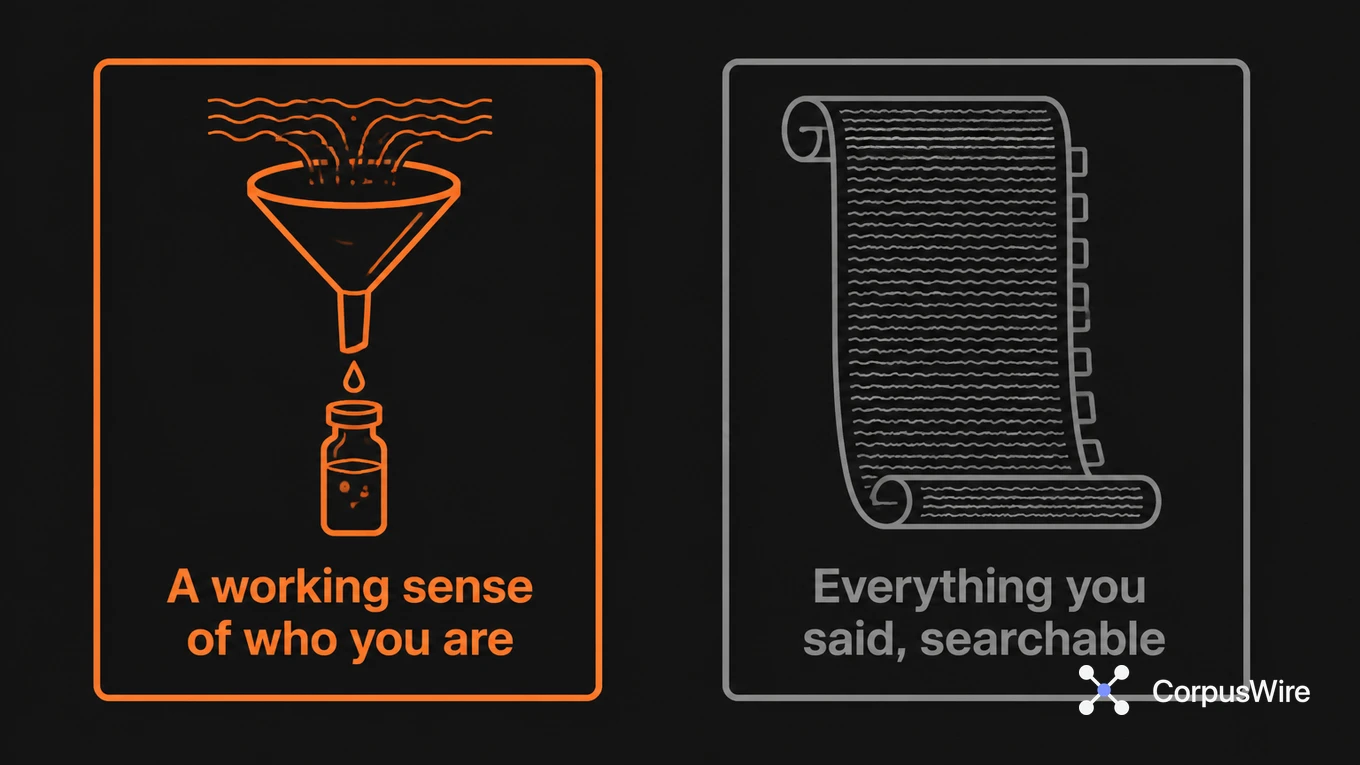
One retains a working sense of who you are and what you care about. The other would retain everything you said, searchable, on purpose, which is a different kind of tool entirely.
There’s also an older system still available for people who want more direct control. OpenAI calls it saved memories: specific facts you’ve explicitly told ChatGPT to remember, like a dietary preference or a standing instruction.
Saved memories work more like a notepad than a synthesis. You can see every entry, edit it, or delete it, and it’s stored separately from your regular chat history.
That system predates the current default and still exists as an option in settings, but it isn’t what runs automatically for most users today.
There’s a practical reason the two systems got split apart. OpenAI’s own documentation on the older approach notes that memories could contradict each other over time.
Something like “training for a marathon” sitting alongside a later “sprained my ankle.” That kind of drift made personalization less accurate the longer the notepad grew unmanaged.
The current synthesis approach updates automatically instead, which fixes the staleness problem but trades away the explicit, line-by-line control the notepad gave you. Neither approach is strictly better. They’re solving different problems: one keeps a manually curated list accurate by hand, the other keeps itself current automatically at the cost of visibility into exactly what it’s holding.
You can also see which memories actually shaped a specific response. ChatGPT surfaces a “sources” view under individual answers showing what was used to personalize that particular reply, including any relevant memories, custom instructions, or past chats it drew from.
That view doesn’t capture every factor behind a response, but it’s the closest thing to a receipt the current system offers. If an answer references something you don’t recognize, checking sources is the fastest way to find out where it came from.
Full, searchable recall of everything that’s ever been said needs a different tool entirely, one that indexes the actual conversation content itself rather than extracting a synthesis from it. A chat tool’s memory feature was never built to be that.
FAQ
If ChatGPT has memory on, why does it still forget things I told it? Because the default memory system builds a synthesis of useful context, not a transcript. If something wasn’t picked up as relevant to that synthesis, or memory was off when you said it, there’s a real chance it won’t carry forward. The conversation itself still technically exists in your chat history, just not in the synthesis. Source: OpenAI’s Memory FAQ (help.openai.com/en/articles/8590148-memory-faq).
Is there a way to actually keep full past conversations searchable? Within ChatGPT itself, the closest option is searching your chat history directly rather than relying on the memory summary, since the raw conversations are stored separately and remain browsable on their own. For anything beyond that, a dedicated document or knowledge store built for retrieval is the real answer, not a chat tool’s memory setting.
Does turning memory off delete my past chat history too? No. Turning off memory stops ChatGPT from using chats to build or update the synthesis going forward. Your actual past conversations remain in your chat history separately, unless you delete them yourself.
Want this running inside your own org?
Happy to show you how this fits your setup. 30-minute call, your documents, no prep needed.
Book a call →