In the Loop· August 27, 2026
What is chunking in RAG, and why does chunk size make or break your AI answers?
Contents
Chunking is the process of splitting a document into smaller pieces before a RAG system indexes it. Each chunk becomes a separate, searchable unit. Get the size wrong and the system either buries the right answer in noise or cuts it off mid-sentence.
Why chunking exists
A RAG system can’t hand an entire document set to a model on every query. Context windows are limited, and even when they aren’t, stuffing a model with irrelevant text degrades its answers rather than improving them.
Chunking solves this by breaking documents into smaller pieces at ingestion time, before any question is ever asked. Each piece gets its own embedding and its own entry in the vector index. When a query comes in, the system retrieves the handful of chunks that match best, not the whole source document.
That’s the whole point of the exercise. Retrieval only works if what it’s retrieving is the right size to be useful. It’s also the core argument behind treating documents as data in the first place: an indexed layer is only as good as the pieces it’s built from.
The main text-chunking approaches
Not all chunking works the same way, and the method matters almost as much as the size.
Fixed-size chunking splits text every N tokens or characters, regardless of what’s on the page. It’s the simplest to implement and the fastest to run at scale, which is why most systems start here. Its weakness is that it cuts wherever the count runs out, which can land in the middle of a sentence or a table row.
Recursive or structure-aware chunking tries to break at natural boundaries instead, like paragraph breaks, headings, or list items, before falling back to a fixed size when a section runs too long. It respects the document’s own structure more closely, which usually means fewer chunks that start or end mid-thought.
Semantic chunking goes a step further and groups sentences by meaning rather than position, using embeddings to detect where the topic actually shifts. It’s the most expensive to compute and the hardest to tune, but it produces chunks that are more likely to be self-contained on any given topic.
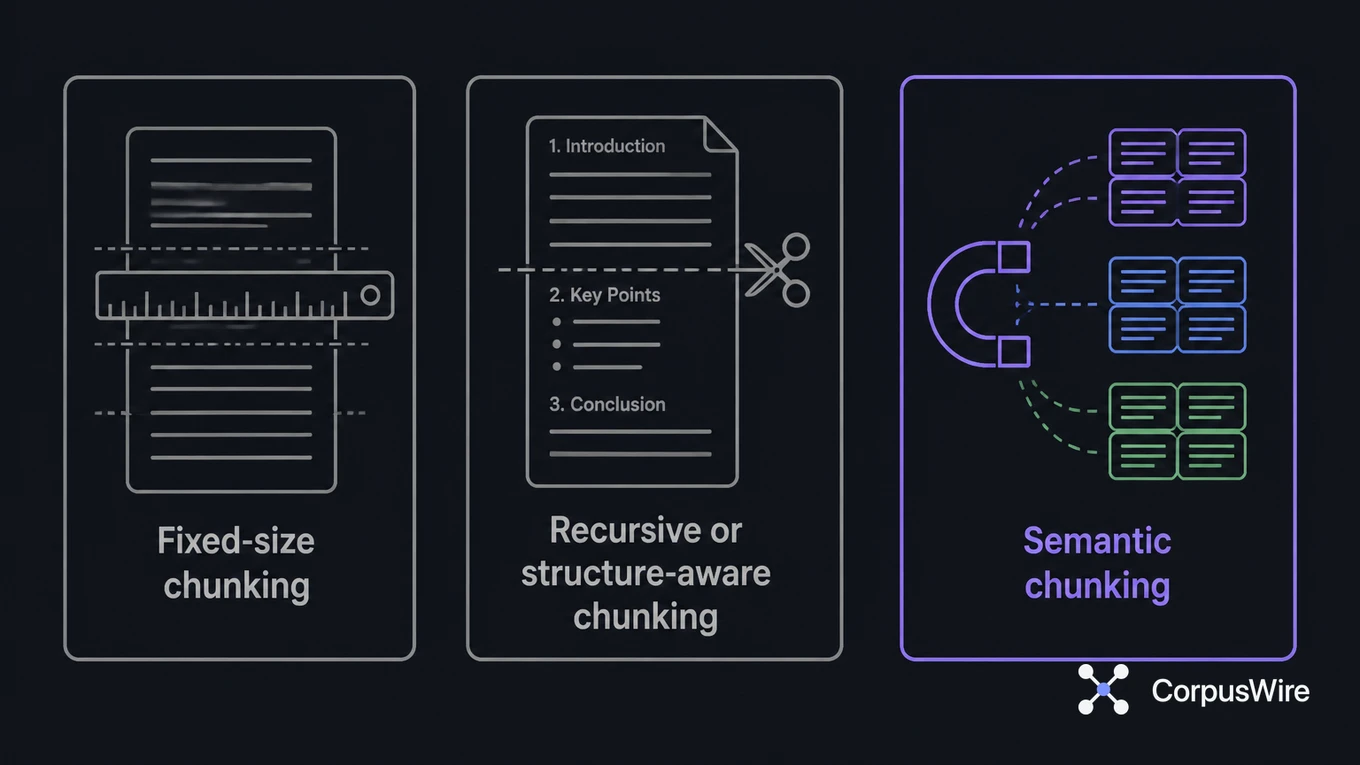
None of these is universally correct. A support-ticket archive with short, self-contained entries chunks well with the simplest method. A long technical manual with nested sections usually needs the structure-aware approach to avoid splitting a procedure from its own prerequisites.
How chunk size actually affects retrieval quality
Chunk size isn’t a minor implementation detail. It’s one of the first things that determines whether a RAG system’s answers are accurate or watered down.
A 2024 study on retrieval-augmented pipelines, “Multi-Source Knowledge Pruning for Retrieval-Augmented Generation”, tested how chunk size affects accuracy inside its own PruningRAG framework and benchmark dataset. The researchers found that increasing chunk size from 50 to 500 tokens steadily improved accuracy, because larger chunks gave the model more surrounding context to work with. Past that point, accuracy dropped again once chunk size reached 1,000 tokens, because the extra length diluted the relevant passage with unrelated content and made it harder for the model to isolate the actual answer.
That’s a U-shaped curve, not a straight line. Too small and a chunk loses the context needed to make sense on its own. Too large and the chunk buries the answer in material the query never asked about.
The two failure modes, in practice
Chunks too small. A chunk that’s cut mid-thought loses the context that made it retrievable in the first place. Split a policy document by sentence and you might retrieve “the fee is waived” without the paragraph explaining when.
The answer is technically in the index. It’s just useless on its own.
Chunks too large. A chunk that spans several unrelated topics dilutes the signal the retrieval step is searching for. The embedding for a 2,000-word chunk covering three different policies is a blur of all three, not a sharp match for any one question. Even when the right chunk gets retrieved, the model has to find the answer inside a wall of tangential text, which is exactly where hallucination risk creeps back in.
Both failure modes look the same from the outside: the AI gives a wrong or incomplete answer. The fix depends on knowing which direction the chunking is wrong in.
Chunk size interacts with your document type
The right chunk size isn’t a fixed number you can carry from one project to the next. A knowledge base built from short FAQ entries behaves differently than one built from long contracts or dense engineering specs.
Short, self-contained source material, like FAQ pairs or ticket resolutions, often works fine with smaller chunks, because each entry already stands on its own. Long-form documents with cross-references, numbered clauses, or multi-step procedures usually need larger chunks or a structure-aware split, so a clause doesn’t get separated from the condition that governs it.
This is also why a single chunk-size setting rarely holds up across an entire mixed document corpus. Teams running RAG over genuinely varied source material often chunk different document types differently, rather than forcing one setting to fit everything.
Overlap matters too
Most production systems don’t chunk with hard, non-overlapping cuts. They add overlap between consecutive chunks, typically 10 to 20 percent of the chunk length, so a sentence that falls near a boundary doesn’t get orphaned from its context.
Overlap has diminishing returns. It helps most at moderate chunk sizes, where a boundary is more likely to fall in the middle of something that matters. At very small chunk sizes, there usually isn’t enough context in a chunk for overlap to meaningfully rescue.
What this means if you’re not the one building the pipeline
You don’t need to tune chunk size by hand to have a stake in this. If a RAG-based tool is giving you answers that feel oddly incomplete, or that quote a fragment without the qualifying detail next to it, chunking is one of the first places to look.
The same applies if answers feel padded with irrelevant context, or if the system seems to “almost” answer the question without landing on the specific detail. That’s the signature of chunks sized too large for the material.
A properly tuned RAG system should retrieve chunks that are self-contained enough to make sense on their own, and narrow enough that the model isn’t sorting through noise to find the relevant sentence. That balance is a chunking decision, made before your question was ever asked.
FAQ
What’s the ideal chunk size for RAG? There isn’t one number that fits every document set. The study cited above found accuracy peaking in the low hundreds of tokens for its own benchmark dataset, with degradation setting in by 1,000 tokens. That’s a result from one framework tested against one dataset, not a universal constant. The right size depends on how your source documents are structured: dense technical manuals and conversational support tickets don’t chunk the same way. Testing against your own document set and query patterns matters more than adopting a default from someone else’s benchmark.
Does chunk size matter more than the embedding model? They solve different problems, so “more important” isn’t quite the right frame. The embedding model determines how well a chunk’s meaning gets captured as a searchable vector. Chunk size determines what that vector is even representing in the first place. A strong embedding model applied to badly sized chunks still produces a precise vector for the wrong unit of text. Both have to be right for retrieval to work; a good embedding model can’t compensate for a chunk that splits the answer from its own context.
Want this running inside your own org?
Happy to show you how this fits your setup. 30-minute call, your documents, no prep needed.
Book a call →