In the Loop· September 3, 2026
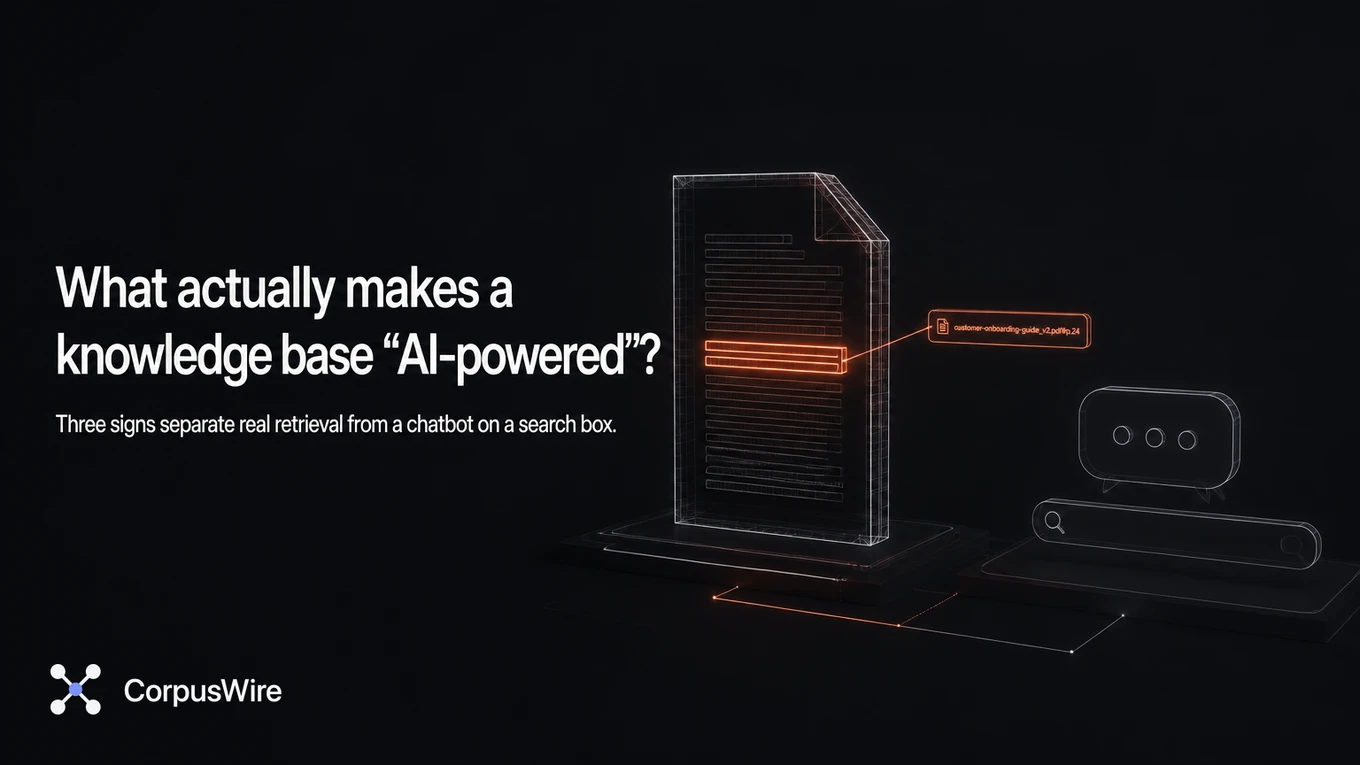
What actually makes a knowledge base “AI-powered”?
Contents
Every vendor selling knowledge management software calls itself “AI-powered” now. Not many of them mean the same thing by it.
Some built real retrieval: a system that indexes your documents and pulls the right passage before it answers. Others bolted a chatbot onto a search box and called the search bar “AI” because it now takes a sentence instead of keywords.
I built CorpusWire’s own retrieval layer, the Brain, because I couldn’t find a knowledge base product that did this well. I tried wikis, CRMs, spreadsheets, and generic databases for years, but nothing really stuck.
The reason is obvious once you think about it. None of them were built to let an AI tool answer from your actual documents instead of guessing at them. That gap is the whole reason this piece exists.
While building the CorpusWire Brain it was clear to see which parts of “AI-powered” marketing are real and which parts are a chat window wrapped around an old search index.
“AI-powered knowledge base” is an unhelpful phrase on its own as all it tells you is that the vendor added AI somewhere. You have no clue whether it’s genuinely useful, or whether it’s answering from a general model’s training with your logo attached.
Here’s a checklist for telling the difference before you buy, not after.
Search plus a chatbot isn’t the same as retrieval
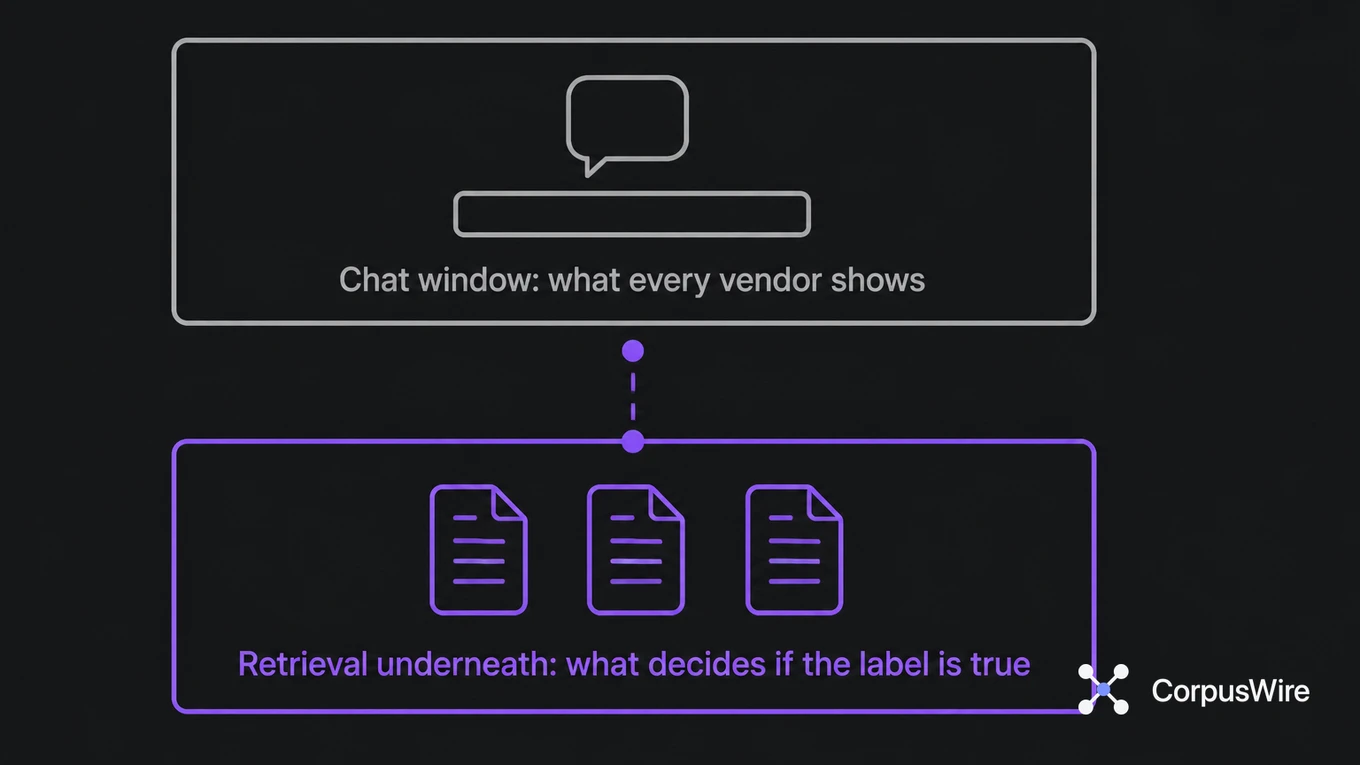
Most “AI knowledge base” products on the market today are the same search index they always were, with a chat window added on top. The chat window is genuinely useful for asking a question in plain language.
Retrieval is a separate capability sitting underneath it, one a chatbot might have or not.
Real retrieval means the system indexes your documents at the passage level, finds the specific piece that answers a query, and can show you where that piece came from. A chatbot layer can sit on top of that, or it can sit on top of nothing at all.
From the outside, both look identical. You type a question, you get a fluent paragraph back. The difference only shows up when you ask where the answer came from, and one system can tell you and the other can’t.
Imagine a support team asking their knowledge base whether a specific policy still applies. A search-plus-chatbot system paraphrases whatever it finds nearby and sounds sure of itself either way.
A system doing real retrieval either points to the current policy document, or tells you it found nothing current. The second answer is less impressive on a demo call. It’s also the only one you can trust with a real decision.
The three signs
None of these three prove, on their own, that a system doesn’t do real retrieval. They’re what you can check from the outside, before a vendor lets you see how the system works underneath.
No chunking. Chunking splits documents into smaller, indexed pieces before a retrieval system searches them. It’s a common way real retrieval finds the right passage instead of returning a whole document or nothing at all.
Chunking isn’t the only valid method, so the actual test is narrower: can the vendor explain any indexing approach at all, chunked or otherwise? One who deflects with “our AI understands your documents” usually can’t.
No citation. A grounded answer can point back to the specific passage it came from. A system can technically retrieve without showing that work in its interface, so the actual risk sits elsewhere.
You simply can’t verify grounding without a visible citation. If a system never shows a document name or a highlighted excerpt, you have no way to check whether an answer is real or hallucinated.
No source pointer. Provenance means an answer traces back to one identifiable document, not a vague “based on your knowledge base” gesture.
Ask a vendor to show you the exact source behind a specific answer, live, on your own content. A real retrieval system doesn’t need to hesitate here. The pointer’s already there.
A system without a real pointer has nothing to show, so expect a stall, or a category name standing in for an actual document. That hesitation, when it happens, is the clearest signal in the whole demo.
What these signs actually rule out
A vendor could have working retrieval and a bad interface that hides the citation. That’s a real possibility, and the checklist above doesn’t rule it out.
What it tells you is narrower and more useful: whether you, the buyer, can verify grounding before you commit budget to it. If you can’t see chunking, a citation, or a source pointer, you can’t verify.
That’s the sign: a limit on what you can verify, not a diagnosis of what’s running in the backend. You’re buying based on what you can check, not what a vendor claims is happening underneath.
Why this matters more than the demo
Most vendor demos look confident. The gap shows up later, when the system answers a question wrong and nobody can tell why, because there was never a way to trace the answer back to anything.
That failure costs more once the system is already live than it would have on a sales call. A wrong answer with no traceable source is a much harder problem to diagnose than a wrong answer you can trace and fix.
A chat interface is the part every vendor shows off. The corpus work underneath it, keeping the index current and every answer traceable, is the part that decides whether the label is true.
How to actually check, before you buy
Three questions do most of the work on a sales call or demo.
Ask to see a real answer sourced against your own documents, not a demo dataset. Vendor demo data is curated to work well. Your own messy, contradictory, half-updated documents are the actual test.
Ask what happens when two of your documents disagree with each other. A system with real retrieval either surfaces both and flags the conflict, or picks one and tells you which. Without conflict-detection, expect the two to blend into something confident and wrong.
Ask how often the index updates when a source document changes. An answer that references last year’s SOP because nobody re-indexed the document is a maintenance failure, not a retrieval one.
Concrete, demonstrated answers to all three point to real retrieval. Vague generalities, or a pivot to an unrelated feature, point to a system that doesn’t have it.
None of this requires you to understand embeddings, vector indexes, or how a language model works underneath. The checklist is deliberately built from things you can see, not things you need an engineering background to evaluate.
That’s also why it holds up across vendors and product categories. A help-desk tool, an internal wiki, and a dedicated AI knowledge base product all face the same three questions, because retrieval either exists and is checkable, or not.
“AI-powered” was never going to be a useful label on its own. What chunking, citations, and source pointers tell you is whether the label describes the product, or just the marketing around it.
FAQ
Is chunking required for a knowledge base to be AI-powered? No. Chunking is a common implementation pattern in retrieval systems, not a universal requirement. What matters is whether the vendor can explain their indexing approach at all, not whether it matches one specific method.
Does a system without visible citations definitely lack real retrieval? Not necessarily. A system can perform retrieval without exposing citations in its interface. The absence just means you can’t verify the answer’s grounding yourself, which is the actual risk you’re taking on.
What’s the fastest way to test a vendor’s claim on a sales call? Bring your own document and ask a question only it answers. A real retrieval system finds it and shows you where. Most systems without it just guess, and sound confident doing it.
Why do so many knowledge base vendors call themselves AI-powered now? Because the phrase sells, whatever’s actually underneath it. Bolting a chat interface onto an existing search index costs a lot less than building real passage-level retrieval, and marketing rarely bothers to tell the two apart.
Want this running inside your own org?
Happy to show you how this fits your setup. 30-minute call, your documents, no prep needed.
Book a call →