In the Loop· September 4, 2026
RAG vs Fine-Tuning: What Small Businesses Need
Contents
Two ways exist to make an AI model know your business. You can fine-tune the model, or you can use retrieval. The choice sounds technical, but it comes down to one thing: how fast your knowledge changes.
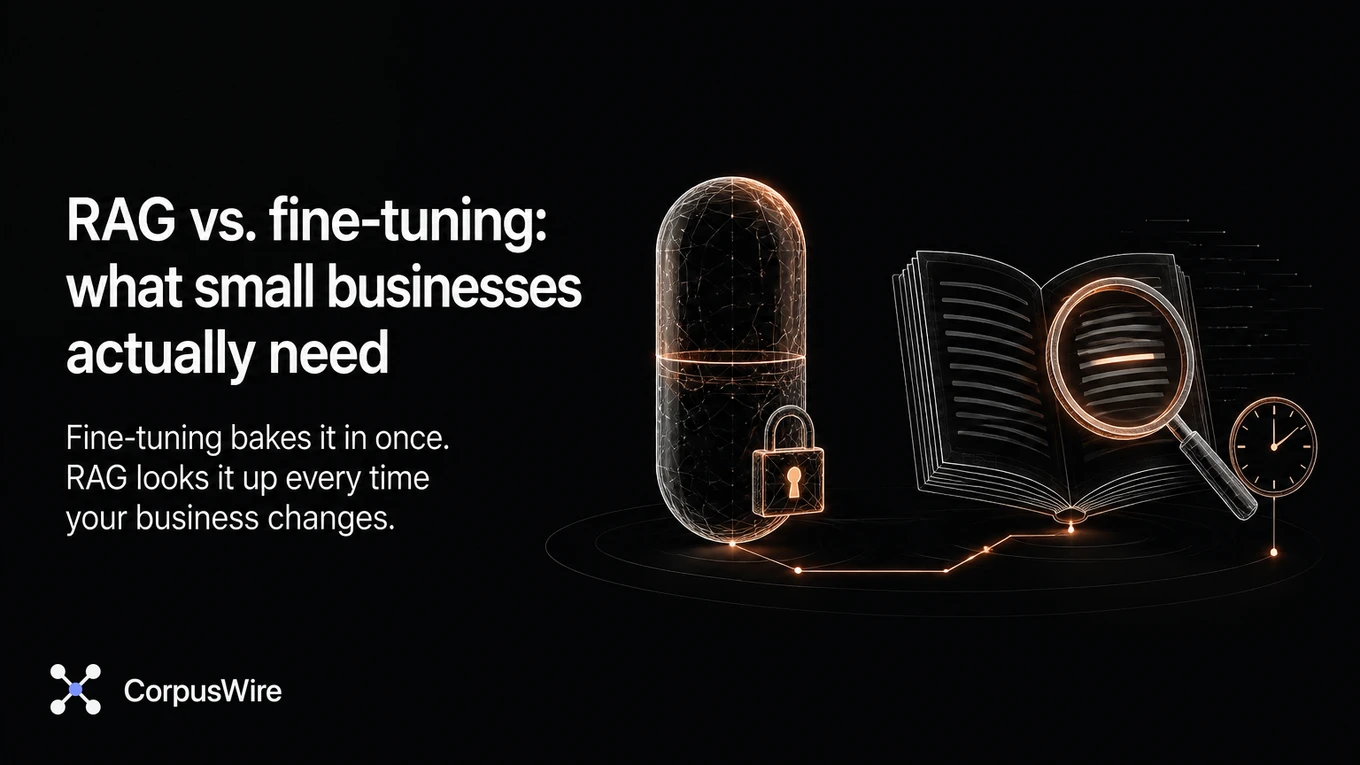
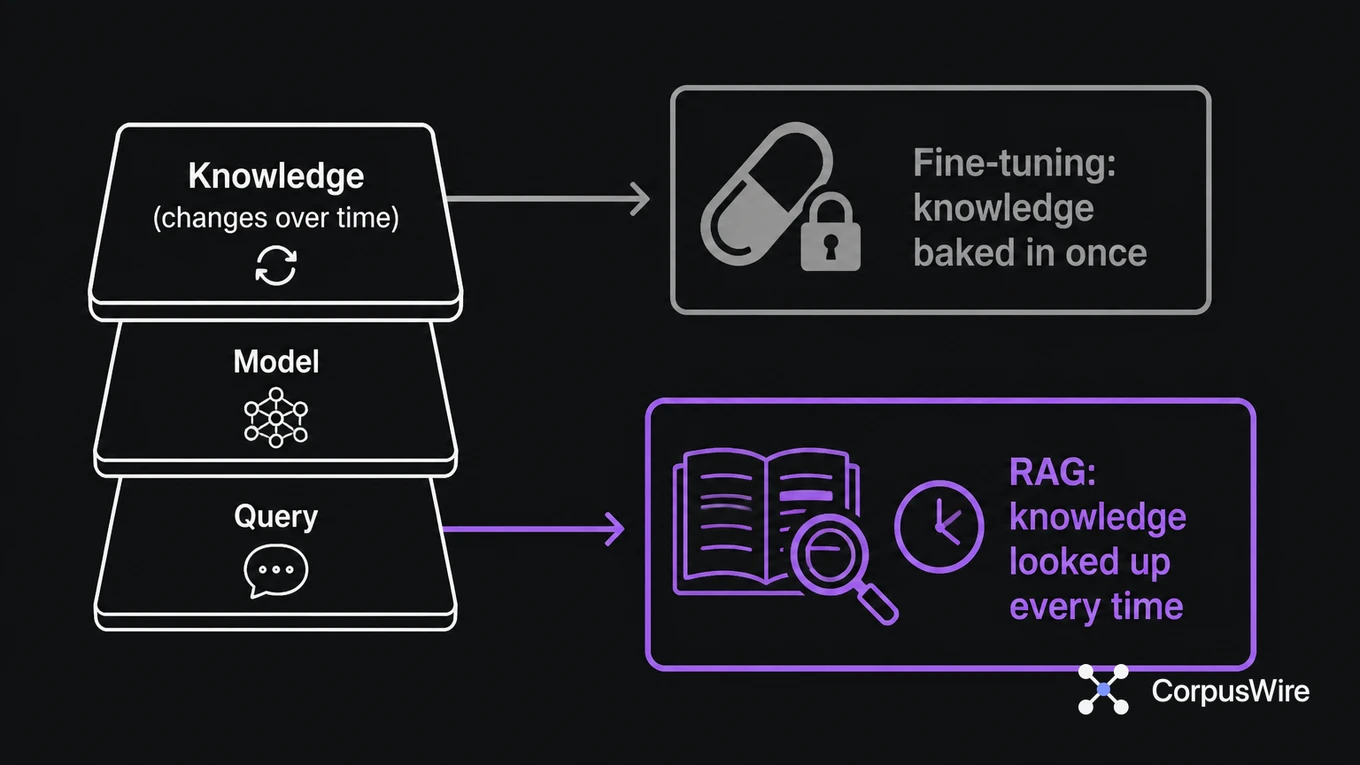
Here’s the plain-English version. Fine-tuning bakes knowledge into the model itself. RAG pulls it in live, at the moment you ask a question.
Small businesses need the second option. Your operating knowledge changes weekly, not yearly. A model that learned your prices last quarter can’t answer about the price you set on Monday.
What fine-tuning does to a model
Fine-tuning retrains a model on your own examples. The knowledge gets absorbed into the model’s weights, the numbers that shape every answer. After training, that knowledge is frozen in place.
This works well for teaching a voice or a format. It struggles with facts that move. Changing one price means retraining, testing, and redeploying the whole model.
For a small team, that’s a heavy loop to run. You’d repeat it every time a policy, price, or product shifted. Your knowledge would still lag behind reality.
It also asks for skills most small teams don’t keep on staff. Someone has to prepare the data, run the training, and check the result each time.
What RAG does instead
RAG leaves the model alone. It keeps your documents in a separate store the model can search. When you ask a question, the system retrieves the relevant passages first, then the model answers from them.
The answer is grounded in your own files. That’s the difference between a model guessing and a model citing. The source sits right there, ready for you to check.
Updating knowledge means updating a document. Change the file, re-index it, and the next answer reflects the change. There’s no retraining, no redeployment, and no waiting.
For the operator-level walkthrough, I explain what RAG means in plain terms.
This is also what separates a real AI knowledge base from a chatbot bolted onto search. I dig into what makes a knowledge base AI-powered elsewhere.
When fine-tuning still makes sense
Fine-tuning isn’t useless; it’s just aimed at the wrong target for facts. Its strength is shaping how a model writes, not what it knows. Think tone, structure, and consistent formatting.
If you want every answer in a house style, fine-tuning can bake that habit in. That’s knowledge that doesn’t change week to week, so baking it in fits. The facts still belong in retrieval.
So the two tools aren’t rivals. Fine-tuning shapes the voice; RAG supplies the facts. For a small business, the facts are what keep moving.
Why weekly beats yearly for small business
Big enterprises can budget for retraining cycles. Their core knowledge shifts slowly, across quarters and years. A small business runs on knowledge that changes by the week.
Think about your last month of work. New prices, a changed process, a fresh FAQ, an updated refund rule. Each one is a fact your AI needs to know today.
Fine-tuning can’t keep pace with that churn. By the time you retrained, the facts would have moved again. Retrieval reads the current document every time, so it stays current for free.
This is the real dividing line between big and small. It isn’t budget or headcount; it’s the speed your knowledge moves. Faster change tilts the choice toward retrieval.
That’s the whole case in one line. Fine-tuning bakes knowledge in for a world that holds still, and RAG retrieves it live for a world that keeps moving.
A worked example: the Monday price change
Picture a price you raised on Monday morning. A customer asks your AI assistant about it that afternoon. You want the new number, not last month’s.
With a fine-tuned model, that new price isn’t in there. The model learned the old figure during training and hasn’t been retrained since. It answers with stale data and sounds confident doing it.
With RAG, you edited the price sheet on Monday. The system re-indexed it, so the afternoon answer pulls the new number. The knowledge moved as fast as your business did.
Multiply that by every price, policy, and product you touch. The gap between a frozen model and a live document widens every week. That gap is exactly what customers feel.
Documents as data, in plain English
Here’s the thesis underneath all of this. Your documents are already your database. You just can’t ask them questions in plain language yet.
RAG turns that pile of files into something answerable. It reads your documents, splits them into chunks, and stores each piece for fast search. How you split them matters, which is why chunk size can make or break answers.
Nothing gets baked into a model here. Your knowledge stays in your documents, where you can see it, edit it, and correct it. That’s data you control, not weights you can’t inspect.
This is why I treat documents as data, not decoration. Every file is a row your AI can query, the moment you ask.
The idea isn’t new. Researchers introduced retrieval-augmented generation in a 2020 paper, pairing a search step with a language model. The plain-English version is simpler: look it up, then answer.
Who keeps control of the knowledge
There’s a quieter benefit hiding in all this. When your knowledge lives in documents, you can read exactly what the AI reads. Nothing is buried inside a model you can’t open.
That matters when an answer goes wrong. You can trace it to a document, fix the source, and re-index in minutes. Fixing a fine-tuned model means another training run.
It also keeps ownership where it belongs. Your files stay yours, editable and inspectable, instead of dissolving into weights. You can see what shapes every answer.
Auditing gets simpler too. Anyone on your team can open the source file and confirm what the AI drew from. Trust follows from that visibility.
What this means for building your brain
So the practical answer is retrieval, not retraining. Point an AI at your documents and let it fetch what’s relevant. Your knowledge updates the moment you update a file.
That’s the foundation of a system I call Build Your Own Brain. It treats your documents as the source of truth. The AI reads from them, and you decide what they say.
The build itself is less scary than it sounds. You connect your documents, let the system index them, and point your assistant at the result. From then on, keeping it current means keeping your files current.
Fine-tuning still has a place for tone and format. For knowledge that changes, retrieval wins every time. If you’re weighing the bigger setup, I compare a knowledge base to an AI operating layer too.
Here’s the short version to carry away. If your knowledge changes weekly, retrieval keeps up and fine-tuning can’t. Build on your documents, and your AI stays as current as they are.
FAQ
Should a small business ever fine-tune a model? Fine-tuning fits when you need a fixed tone or output format. For facts that change weekly, retrieval is the better tool.
Does RAG cost less than fine-tuning? Usually, yes, because you skip repeated retraining runs. You still pay to store and index documents, but updates stay cheap.
How fast does new information show up with RAG? As soon as you re-index the changed document. There’s no model retraining step to wait on.
Do I need a data scientist to run RAG? No, not for most setups. A small business can connect its documents to a retrieval system without training a model.
Want this running inside your own org?
Happy to show you how this fits your setup. 30-minute call, your documents, no prep needed.
Book a call →