In the Loop· August 18, 2026
Knowledge management system vs. an AI operating layer: what’s actually different

Contents
Your AI assistant just confidently told a customer something that’s been wrong for three weeks. It didn’t lie. It read your knowledge base exactly the way it was built to be read — by a person, not by a machine mid-task. That gap is the whole problem, and most teams don’t find it until it’s already cost them something.
A knowledge management system helps a person find information. Most teams build that on a knowledge base: a searchable library of articles, docs, and policies.
An operating layer is a different thing entirely. It helps an AI tool use that information while it’s doing a job, mid-task, without anyone opening a tab. That’s the real difference, and most teams don’t notice it until an AI assistant confidently hands a customer the wrong answer from a document that’s been stale for three weeks.
The industry sells these as interchangeable. They aren’t. A knowledge base is a library: organized, searchable, completely inert until someone opens it.
An operating layer is closer to memory. It’s read continuously, by machines, as part of doing the work, not as a separate errand a human has to remember to run.
The stakes are bigger than they look. McKinsey Global Institute research puts the average knowledge worker at close to 1.8 hours a day, over 9 hours a week, searching and gathering information rather than doing the job itself.
A knowledge management system built only for human search inherits that cost. An AI assistant plugged into the same system inherits it too, just faster and with more apparent confidence.
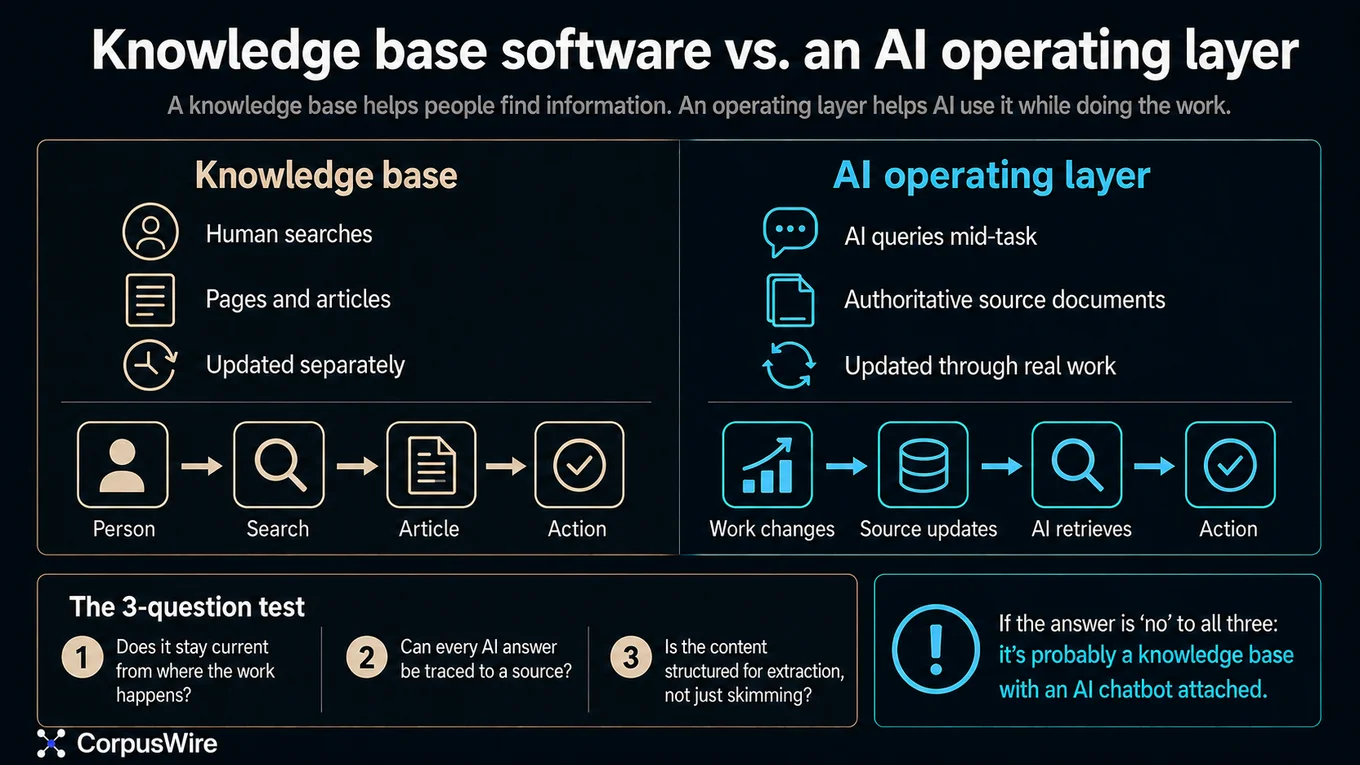
What a knowledge base actually does
A knowledge base’s job is retrieval by a human. You have a question, you search, you find an article, you act on what you read. Confluence, Notion, a help-desk library: every tool in this category is built for that loop, with good search, readable formatting, categories a person can browse.
Most of them don’t make their contents available to an AI assistant the moment it needs them, at least not in a way that’s reliable. The information exists. Whether an AI tool can reach it, parse it correctly, and cite it accurately is a different problem, one most knowledge management systems were never built to solve. That gap is exactly what CorpusWire’s first law is about: an asset you can’t reach isn’t an asset, it’s storage.
What changes with an operating layer
An operating layer indexes the same kind of content (documents, policies, decisions, product specs) for a different audience. Instead of a person searching once and reading the result, an AI assistant queries it constantly, without a human deciding to go look something up.
That shift changes what “good” content looks like. A knowledge base article can bury the answer in paragraph four, as long as the heading gets a human close enough to skim to it.
An operating layer can’t afford that, because the system reading it isn’t skimming: it’s pulling one chunk of text and treating that chunk as the whole answer. Bury the useful sentence, and the AI tool either misses it or answers confidently from something earlier and less accurate instead.
This is why CorpusWire calls its version the Brain. Not a repository you open, but a memory layer sitting underneath your AI tools, built from your actual operating corpus: the documents, decisions, and context your team already produces, instead of a separate wiki someone has to remember to update.
How to tell which one you actually have
Most teams assume they already know. In practice the line is easy to miss, because the software looks identical from the outside (same search bar, same article layout). Three questions actually separate them.
Does the content update itself from where the work happens, or does someone have to remember to update it?
A knowledge base almost always depends on someone manually revising a page after a process changes. An operating layer is built from documents your team is already producing (meeting notes, decisions, specs), so it can reflect reality without a separate maintenance step, if it’s actually wired into that workflow and not just pointed at a folder. If it doesn’t, it isn’t really an operating layer yet, whatever the vendor calls it.
When an AI tool answers a question, can you trace that answer back to a source?
If the honest reply is “probably, somewhere in there,” that’s a warning sign. Traceability is the whole value proposition. An assistant that can’t point to where an answer came from is a liability the moment people start trusting it by default.
Is the content written for a person skimming, or a system extracting one answer at a time?
Long-form explanation, buried qualifiers, three paragraphs of setup before the point: all of it works fine for a human. All of it hurts AI retrieval, because the system pulls a chunk and treats it as self-contained, not read in context the way a person would.
Answer “not really” to all three, and what you actually have is a knowledge management system with an AI chatbot bolted on. Useful. Not the same thing, and not what solves this problem.
What this looks like in practice
Say a customer asks your support AI whether your product integrates with a specific tool. In a knowledge base setup, the AI searches the article library and answers from whatever it retrieves, maybe an article from eight months ago, written before the integration shipped, sitting next to three others that say something slightly different.
In an operating layer setup, the same question gets answered from the source your engineering team actually works from: the current integration spec, updated when the integration itself last changed, not whenever someone remembered to revisit the help center. The AI isn’t smarter here. It’s reading from a source that’s much less likely to go stale, because staying current is built into the workflow instead of sitting on someone’s to-do list as a separate task.
This is also why “just add more AI” rarely fixes accuracy on its own. A more capable model reading from the same disorganized, out-of-date knowledge management system still tends to retrieve the wrong article.
It just says the wrong thing more fluently. The fix is almost never a better model. It’s usually the layer underneath it.
Why this matters now, not eventually
Most teams already have some AI assistant plugged into their tools: a chatbot on internal questions, an agent drafting replies, a copilot summarizing tickets. Those tools are only as accurate as what they retrieve. Point them at a knowledge management system built for human search, and they inherit its blind spots: stale pages nobody flagged, answers split across three articles, content written for a person’s context instead of a machine’s.
That gap compounds. If a knowledge worker already loses close to two hours a day hunting for the right document, an AI assistant reading from that same disorganized source doesn’t remove the hunt, it just moves it behind the scenes and hides how often the answer is wrong.
Fixing that doesn’t mean ripping out the knowledge base you already have. It means deciding that the documents your team already produces, not a separate content project, are the source of truth your AI reads from, kept current because it’s plugged into your real workflow instead of a wiki nobody’s assigned to maintain.
What switching actually requires
This isn’t a rip-and-replace call. Most teams don’t need to abandon the knowledge management system they already use for human-facing search: support articles, onboarding docs, internal wikis still have a real audience that would rather read a page than ask an assistant. The operating layer question is narrower: does the content your AI tools answer from come from the same source your team actually works from, or from a separate library someone has to remember to sync?
Three things, in practice. Find which documents are actually authoritative: the current spec, not last quarter’s draft sitting in the same folder.
Structure those documents so an AI system can extract a direct answer, not just find them. Connect the AI tools that need this information to that source directly, instead of a manually maintained copy that drifts the first time someone updates one but not the other.
None of this needs a new tooling category nobody’s heard of. It needs treating “what does our AI actually read from” as a deliberate infrastructure decision, not whatever happened to get plugged in first. That’s the whole idea behind CorpusWire’s Brain: a memory layer built from the corpus your team is already producing, so your AI tools are reading from the same source your people work from, not a copy someone has to remember to keep in sync.
FAQ
What’s the difference between a knowledge base and a knowledge management system? A knowledge base is typically a single searchable content library: articles, docs, FAQs. A knowledge management system is broader, covering the processes and tools for capturing, organizing, and surfacing organizational knowledge, of which a knowledge base is often one piece. Neither term implies the content is structured for AI retrieval; that’s a separate requirement on top.
Can AI tools read a knowledge base directly? Technically, often yes. Many AI tools can be pointed at a knowledge base’s content via search or an API. Whether they read it well is a different question. Content written for human skimming is harder for an AI system to retrieve accurately than content structured with direct answers and consistent formatting. That’s the actual design difference between a knowledge management system and an operating layer, not just where the content lives.
Do we need to migrate everything out of our existing knowledge base to build an operating layer? No. The distinction is which content your AI tools query for answers, not where every document physically lives. A knowledge base can keep serving human search while a smaller, clearly identified set of authoritative documents (specs, current policies, decisions) gets structured and connected as the operating layer your AI assistants actually read from. Migrating everything at once is usually the slower, riskier path. Starting with the documents your AI tools are already getting wrong is faster, and shows the value immediately.
This is the first post in CorpusWire’s ‘In The Loop’ series: practical explainers on building an AI operating layer, not just an AI-adjacent knowledge management system. documents-as-data covers the full thesis; build your own brain walks through the stages.
Want this running inside your own org?
Happy to show you how this fits your setup. 30-minute call, your documents, no prep needed.
Book a call →